

Views: 0 Author: Site Editor Publish Time: 2026-09-07 Origin: Site
A 50 HP tractor gives you plenty of flexibility for pasture mowing, grass cutting and general vegetation management. But choosing the right rotary cutter is not simply a matter of matching “50 HP” to a certain cutter width.
If you are looking for a rotary cutter for a 50 HP tractor, you will need to consider several factors, including PTO horsepower, vegetation density, terrain, implement weight and the cutter’s duty rating. In many applications, a 50 HP tractor can work with a 5-, 6- or 7-foot rotary cutter, but the best choice depends on the actual working conditions and the specifications of both machines.
Choosing a cutter that is too small may reduce your working efficiency, while an oversized or excessively heavy cutter can place unnecessary demands on the tractor.
This guide explains what size rotary cutter you can use with a 50 HP tractor, how 5-, 6- and 7-foot cutters compare, and what you should check before purchasing a tractor-and-implement combination.
There is no universal cutter size for every 50 HP tractor. Two tractors with the same engine horsepower may have different PTO output, weight, hydraulic capacity, and hitch specifications.
As a general starting point:
| Rotary Cutter Width | Typical Applications | Consideration for a 50 HP Tractor |
|---|---|---|
| 4–5 ft | Small fields, property maintenance, lighter grass | Generally easy to handle |
| 5–6 ft | Pastures, grass fields, general mowing | A common choice |
| 6–7 ft | Larger fields, heavier grass, pasture maintenance | Often suitable, depending on PTO HP |
| 7–8 ft | High-productivity mowing and heavy-duty applications | Requires careful specification matching |
These are working guidelines rather than fixed rules. Always compare the cutter manufacturer's minimum PTO horsepower requirement with the tractor's actual PTO output.
A wider cutter is not automatically the better choice. If it places too much demand on the tractor, the operator may have to reduce ground speed, raise the cutter more often, or make multiple adjustments to maintain cutting performance.
For a farm or dealership purchasing equipment, matching the implement to the tractor's actual specifications is more important than choosing the widest cutter available.
One of the most common mistakes when selecting a rotary cutter is looking only at engine horsepower.
A tractor rated at 50 HP does not necessarily deliver 50 HP through the PTO.
The engine drives several systems on the tractor, and some power is lost between the engine and PTO. Rotary cutters use PTO power to drive their gearbox and cutting blades, so the implement manufacturer's minimum PTO horsepower requirement is a critical specification.
For example:
Engine horsepower → PTO output → Rotary cutter requirement
The correct question is therefore not:
“Can a 50 HP tractor run a 7-foot cutter?”
A better question is:
“Does this tractor provide enough PTO horsepower and lifting capacity for this particular 7-foot cutter under the intended working conditions?”
This distinction becomes especially important when comparing rotary cutters from different manufacturers. Cutter weight, blade design, gearbox rating, cutting capacity, and intended vegetation can all affect the required tractor power.
Before placing an equipment order, check the following specifications on both machines:
Tractor engine horsepower
Tractor PTO horsepower
PTO speed
Minimum PTO horsepower required by the cutter
Three-point hitch category
Hitch lift capacity
Cutter operating weight
PTO shaft specifications
For a 50 HP tractor, the choice between a 5-, 6-, and 7-foot cutter usually comes down to the type of work and the productivity expected from the machine.
A 5-foot cutter is a practical option when maneuverability is more important than maximum field coverage.
It can make sense for:
Smaller fields
Narrow access areas
Small farms
Property maintenance
Light to medium grass
Areas with obstacles
The smaller working width also reduces the implement's overall weight and power requirement in many cases.
For contractors or property owners who frequently work around trees, fences, buildings, or irregular boundaries, a smaller cutter can sometimes be more productive despite covering less ground per pass.
A 6-foot cutter is often a good middle ground for a 50 HP tractor.
It provides more coverage than a 5-foot unit while remaining manageable for many tractors in this horsepower range.
Typical applications include:
Pasture mowing
Grass field maintenance
Weed control
Farm road maintenance
General vegetation management
For a mixed-use farm, this size can offer a useful balance between cutting width, maneuverability, transport, and tractor power.
A 7-foot cutter can significantly increase mowing productivity in larger, relatively open areas.
It is particularly useful when the tractor is being used for:
Large pastures
Open grassland
Regular field maintenance
Heavy grass
Larger acreage
However, the additional foot of cutting width also means a larger implement footprint and, depending on the model, substantially more implement weight.
Before selecting a 7-foot cutter, verify:
PTO horsepower
Three-point hitch capacity
Cutter weight
Tractor ballast requirements
Ground conditions
Type and density of vegetation
A 7-foot cutter that is technically compatible on paper may not be the most productive choice if the tractor struggles to maintain the required operating speed in heavy vegetation.
Horsepower is only one part of the equation. For commercial and farm applications, several other specifications can affect the correct cutter size.
Start with the cutter manufacturer's PTO horsepower requirement.
Do not use engine horsepower as a substitute for PTO horsepower when comparing implement requirements.
If the cutter requires more PTO power than the tractor can deliver, the operator may experience reduced performance, slower cutting speeds, or excessive engine load.
Cutting short grass is very different from clearing thick weeds or woody brush.
For example:
Short grass generally requires less power.
Tall, dense grass increases load on the cutter.
Thick weeds require more cutting capacity.
Brush and small saplings require a heavy-duty machine designed for that work.
If a tractor will be used primarily for pasture maintenance, a standard rotary cutter may be sufficient. If it will regularly clear heavy brush, the buyer should look at the cutter's rated cutting capacity, gearbox, blade carrier, and deck construction rather than choosing based on width alone.
Field conditions can change the practical performance of a tractor and cutter combination.
Flat, dry fields are relatively straightforward.
Hills, wet ground, soft soil, and uneven terrain require more attention to traction and stability.
This is one reason four-wheel drive can be valuable for tractor-implement combinations used in difficult conditions.
A 4WD tractor can provide additional traction when working on slopes or in soft ground, although 4WD does not replace the need to select an appropriately sized implement.
The cutter must be compatible with the tractor's three-point hitch.
A tractor may have enough engine and PTO power to operate a cutter but still have limitations when lifting or transporting a heavy implement.
Check:
Three-point hitch category
Maximum lift capacity
Implement weight
Weight distribution
Rear ballast requirements
This is particularly important with heavy-duty rotary cutters.
Working width affects field productivity.
A wider cutter covers more ground in each pass, but it also increases the power and lifting requirements.
For example, a 7-foot cutter theoretically covers approximately 17% more width than a 6-foot cutter on every pass. But actual productivity also depends on ground speed, field conditions, turning time, and how effectively the tractor can maintain its working speed.
For a commercial farm or mowing contractor, these factors can matter more than the nominal cutter width.
Tractor weight is sometimes overlooked when buyers compare horsepower ratings.
A tractor needs enough weight and traction to control the implement safely, particularly when working on slopes or transporting a heavy cutter.
A lightweight 50 HP tractor and a heavier 50 HP tractor may behave differently with the same rotary cutter.
This is why buyers should look beyond horsepower and compare:
Operating weight
Wheelbase
Tire configuration
Ballast
Three-point hitch capacity
PTO output
For dealers and importers, these specifications are also useful when deciding which cutter models should be offered alongside a particular tractor model.
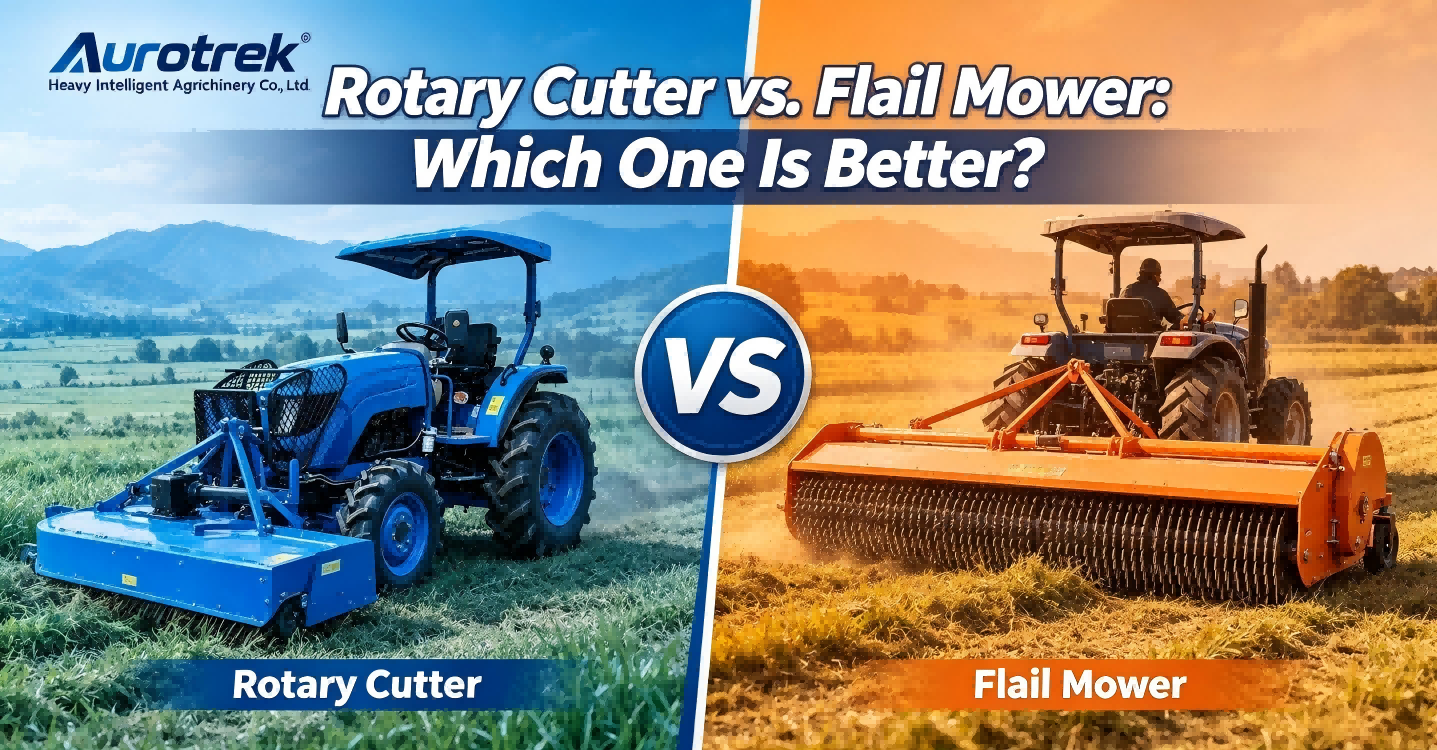
The right implement also depends on the desired finish and type of vegetation.
A rotary cutter is commonly used for pasture and rough vegetation where productivity and durability are priorities.
A flail mower uses multiple flails mounted on a rotor and can produce a more refined cut in many applications. It is commonly considered for grassland, roadside vegetation, orchard maintenance, and applications where the finish is more important.
A simple comparison:
| Application | Rotary Cutter | Flail Mower |
|---|---|---|
| Pasture mowing | Excellent | Excellent |
| Tall grass | Excellent | Excellent |
| Rough vegetation | Excellent | Good–Excellent |
| Brush management | Good with suitable heavy-duty model | Good with suitable model |
| Fine finish | Moderate | Generally better |
| Simple field maintenance | Very suitable | Suitable |
| Initial equipment cost | Often lower | Often higher |
For U.S. buyers, the term “bush hog” is also commonly used when referring to a rotary cutter. “Bush Hog” is, however, also a specific equipment brand, so the terms should not always be treated as interchangeable.
European buyers may be more familiar with terms such as rotary mower or flail mower, depending on the application.
In many applications, a 50 HP 4WD tractor can be paired with a 6- or 7-foot rotary cutter, provided that the tractor and implement specifications are compatible.
The 4WD system is particularly useful where traction is a concern.
Typical applications include:
Pasture mowing
Grassland maintenance
Wet fields
Sloped land
Rough farm roads
General vegetation management
However, four-wheel drive should not be used as a reason to oversize the implement.
The tractor still needs sufficient PTO horsepower, lift capacity, and operating weight for the selected cutter.
For a 50 HP diesel tractor intended to work with several PTO-driven implements, buyers should also consider the tractor's transmission, hydraulic system, three-point hitch, PTO configuration, and availability of compatible attachments.
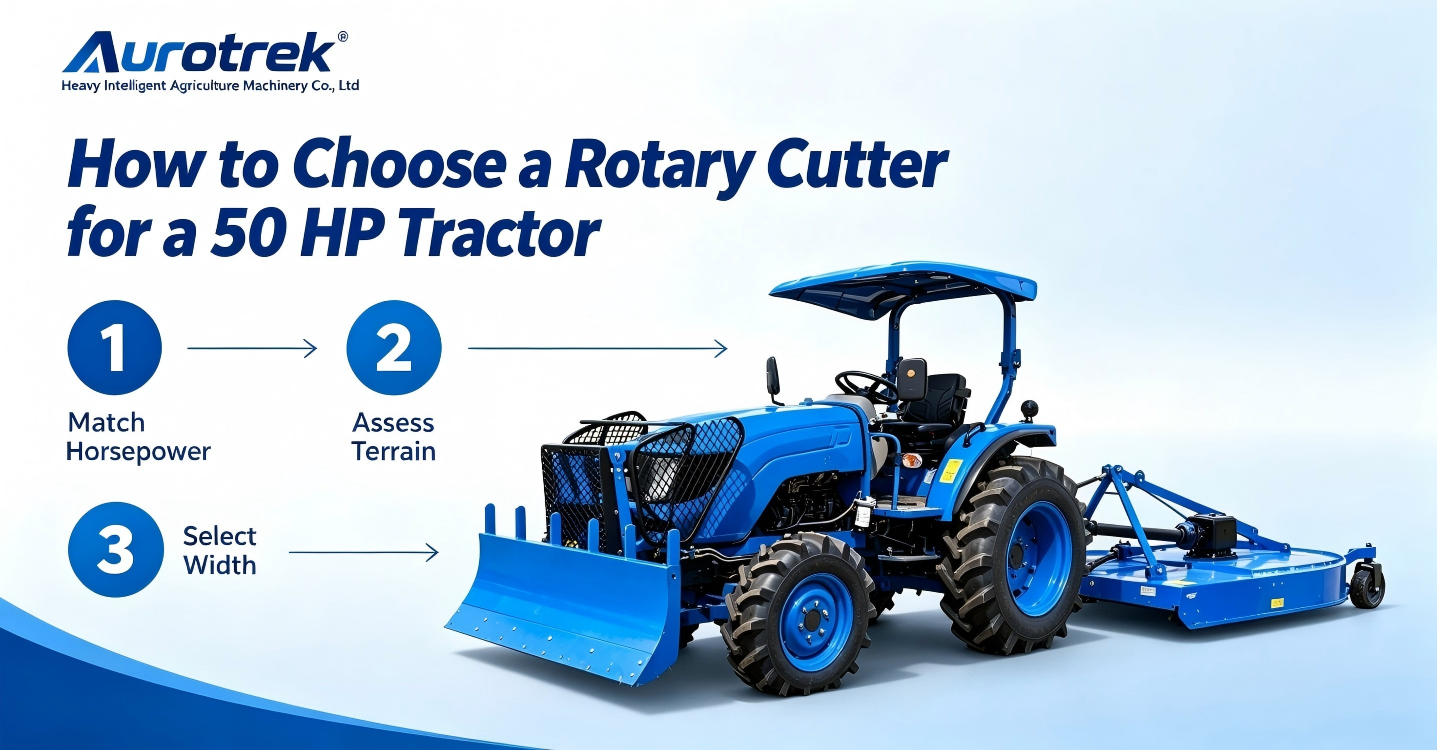
Before purchasing a rotary cutter, use the following checklist.
Engine horsepower
PTO horsepower
PTO speed
Operating weight
Four-wheel drive configuration
Three-point hitch category
Hydraulic and lift capacity
Cutting width
Minimum PTO horsepower
Operating weight
Maximum cutting capacity
Recommended cutting height
Gearbox rating
PTO shaft specifications
Three-point hitch compatibility
Grass or brush?
Flat or sloped terrain?
Dry or wet soil?
Small fields or large open acreage?
Occasional or continuous commercial use?
Once these factors are known, the correct cutter size becomes much easier to determine.
Suppose a farm is considering a 50 HP 4WD diesel tractor for regular pasture maintenance.
The operator needs to mow relatively open grassland several times a year and wants reasonable field productivity.
A 5-foot cutter would provide good maneuverability but require more passes.
A 6-foot cutter may provide a better balance between coverage and maneuverability.
A 7-foot cutter could improve productivity further, provided that the tractor has sufficient PTO horsepower and lift capacity for the selected model.
If the same tractor will instead be used for dense brush, slopes, and wet ground, the buyer may prioritize a heavy-duty cutter and tractor traction rather than simply selecting the widest available implement.
The “best” combination therefore changes with the job.
A 5- to 7-foot rotary cutter can be a practical range for many 50 HP tractors. The final choice should be based on PTO horsepower, cutter weight, vegetation, terrain, and the manufacturer's specifications.
It can in many cases, but it depends on the specific tractor and cutter. Check the cutter's minimum PTO horsepower requirement and the tractor's PTO output before purchasing.
A 6-foot cutter generally offers easier handling and lower power requirements, while a 7-foot cutter can provide greater field coverage. For larger open fields, the 7-foot option may improve productivity if the tractor can handle it effectively.
The requirement varies by cutter size, design, and duty rating. Always use the implement manufacturer's stated minimum PTO horsepower rather than estimating the requirement from cutter width alone.
“Rotary cutter” is the general equipment term. “Bush hog” is commonly used in the United States as a generic term for this type of implement, while Bush Hog is also a specific manufacturer.
Many 50 HP tractors can operate flail mowers, but compatibility depends on the mower's PTO requirement, weight, working width, and duty rating.
Choosing a rotary cutter for a 50 HP tractor is less about finding a fixed horsepower-to-width formula and more about matching the complete tractor-implement combination.
For many applications, 5-, 6-, and 7-foot cutters are worth considering. The final decision should come down to:
PTO horsepower + cutter weight + working width + vegetation + terrain + hitch capacity.
For farms, contractors, dealers, and equipment importers, this approach provides a more reliable way to specify equipment than selecting an implement based on engine horsepower alone.
If you are sourcing a 50 HP 4WD diesel tractor for use with rotary cutters and other PTO-driven implements, review the tractor's PTO, three-point hitch, hydraulic, transmission, and weight specifications together with the intended implement requirements. This will give you a much clearer picture of the equipment combination before placing an order.


