

Views: 0 Author: Site Editor Publish Time: 2026-08-25 Origin: Site
What is a tractor used for? A farm tractor is a versatile power machine used for much more than pulling equipment. With the right implements, it can prepare soil, plant crops, apply fertilizer, mow fields, move materials, haul loads, and support harvesting operations.
The key is matching the tractor’s horsepower, traction, PTO, hydraulics, and hitch capacity to the job. In this guide, we’ll look at the most common tractor uses and explain what to consider when choosing a tractor for your farm.
A tractor is designed to deliver high pulling force, stable low-speed power, and control for agricultural equipment. Unlike a road vehicle, its main purpose is not transportation. It is built to work in soil, grass, mud, slopes, and other demanding farm conditions.
Modern tractors typically use several systems together:
Engine power provides the energy for travel and equipment operation.
Transmission and drive axles deliver torque to the wheels or tracks.
Three-point hitch connects mounted implements such as plows, cultivators, and seeders.
Power take-off (PTO) drives machinery such as mowers, balers, pumps, and rotary tillers.
Hydraulic system raises, lowers, and controls implements, loaders, and other attachments.
Drawbar or towing connection pulls trailers and larger trailed equipment.
This flexibility makes the tractor one of the most important machines on a farm.
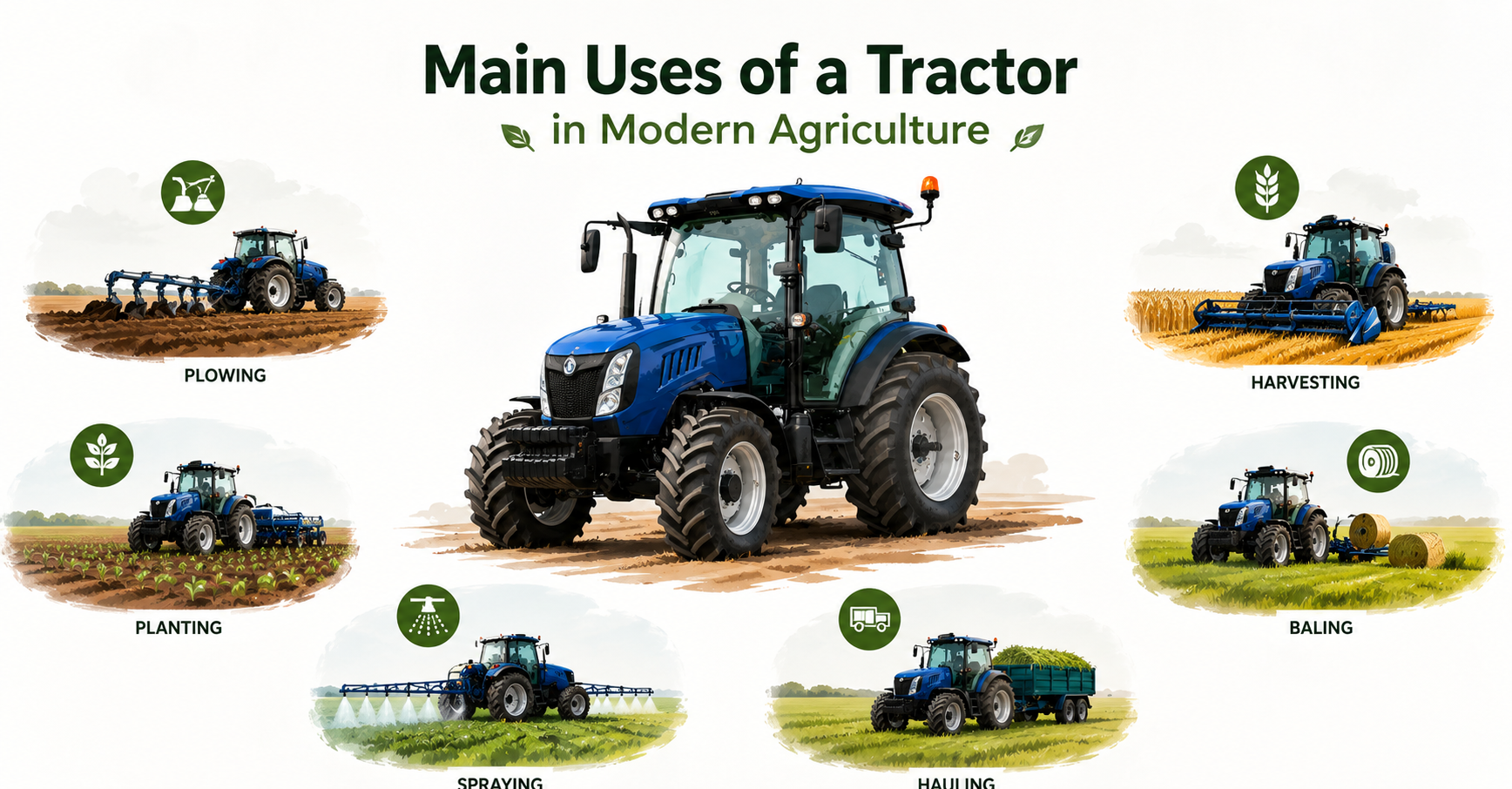
Field preparation is one of the tractor’s most common jobs. Before seeds are planted, soil may need to be loosened, leveled, mixed, or shaped for the crop and local conditions.
A tractor can pull or power equipment such as:
Plows for turning or loosening soil
Disc harrows for breaking clods and mixing crop residue
Cultivators for shallow soil work and weed control
Rotary tillers for creating a finer seedbed
Land levelers and blades for improving field surface conditions
Bed formers for vegetable and specialty-crop production
The right tractor must provide enough traction and drawbar power for the implement. In heavy soil or wet ground, insufficient traction can cause wheel slip, wasted fuel, and uneven working depth.
Tractors support accurate and timely crop establishment. Depending on the farm, they may pull seed drills, precision planters, fertilizer applicators, or transplanting equipment.
This work helps farmers place seeds or seedlings at the correct depth, row spacing, and population. Consistent planting supports more uniform crop emergence and simplifies later field operations.
For rice, vegetables, and other transplanted crops, tractors can also work alongside specialized planting machines. A well-matched power unit and implement combination helps operators maintain a steady speed while working across uneven ground.
During the growing season, tractors are widely used with fertilizer spreaders, sprayers, and other field-management equipment. These operations can include:
Applying granular or liquid fertilizer
Spraying crop-protection products
Applying biological treatments
Managing weeds between crop rows
Mowing grass around field edges, orchards, and access roads
Reliable hydraulic control and stable steering are especially important when carrying or pulling sprayers on uneven fields. Tractor size should also match the weight of the equipment and the working width needed to cover the farm efficiently.
A tractor does not only pull equipment. Its PTO transfers rotary power from the engine to an implement.
PTO-driven implements commonly include:
Rotary tillers
Flail mowers and slashers
Hay balers
Forage choppers
Grain augers
Irrigation pumps
Wood chippers
Feed-processing equipment
Before operating PTO-driven machinery, the operator should confirm the required PTO speed, shaft connection, guard condition, and power requirement. Matching the PTO output to the implement protects both the tractor and the equipment.
With a front-end loader, forks, bucket, or rear-mounted lifting attachment, a tractor becomes a practical materials-handling machine.
It can move:
Soil, gravel, and compost
Fertilizer bags and bulk materials
Hay and straw bales
Feed and bedding
Pallets and farm supplies
Harvested crops and containers
Loader work requires special attention to hydraulic capacity, lift height, rear ballast, tire condition, and ground stability. Carrying a heavy load too high can reduce visibility and make the tractor less stable.
Tractors frequently pull trailers to transport harvested produce, seed, fertilizer, tools, and other materials around the farm. This is useful where field roads are rough or where trucks cannot easily reach the working area.
The tractor must have adequate power, braking performance, and weight for the trailer load and terrain. Operators should also consider slope, road conditions, trailer brakes, and the overall center of gravity before hauling heavy loads.
A tractor often plays a supporting role during harvest, even when a self-propelled harvester performs the main crop collection work. It may pull grain carts, trailers, forage wagons, or bale trailers. It can also power equipment for cleaning, loading, or handling harvested material.
In livestock and forage operations, tractors are essential for mowing, raking, baling, moving bales, and preparing feed. Their ability to work with different attachments helps reduce manual handling and keeps seasonal work moving.
A tractor remains useful outside the main planting and harvest seasons. With the appropriate attachment, it can help maintain roads, drainage areas, livestock facilities, orchards, and storage yards.
Common maintenance tasks include:
Grading farm lanes
Clearing brush and weeds
Digging or light backhoe work
Cleaning livestock areas
Moving feed and bedding
Clearing snow in colder regions
Running pumps or generators
This year-round versatility is a major reason why many farms consider the tractor their core machine.
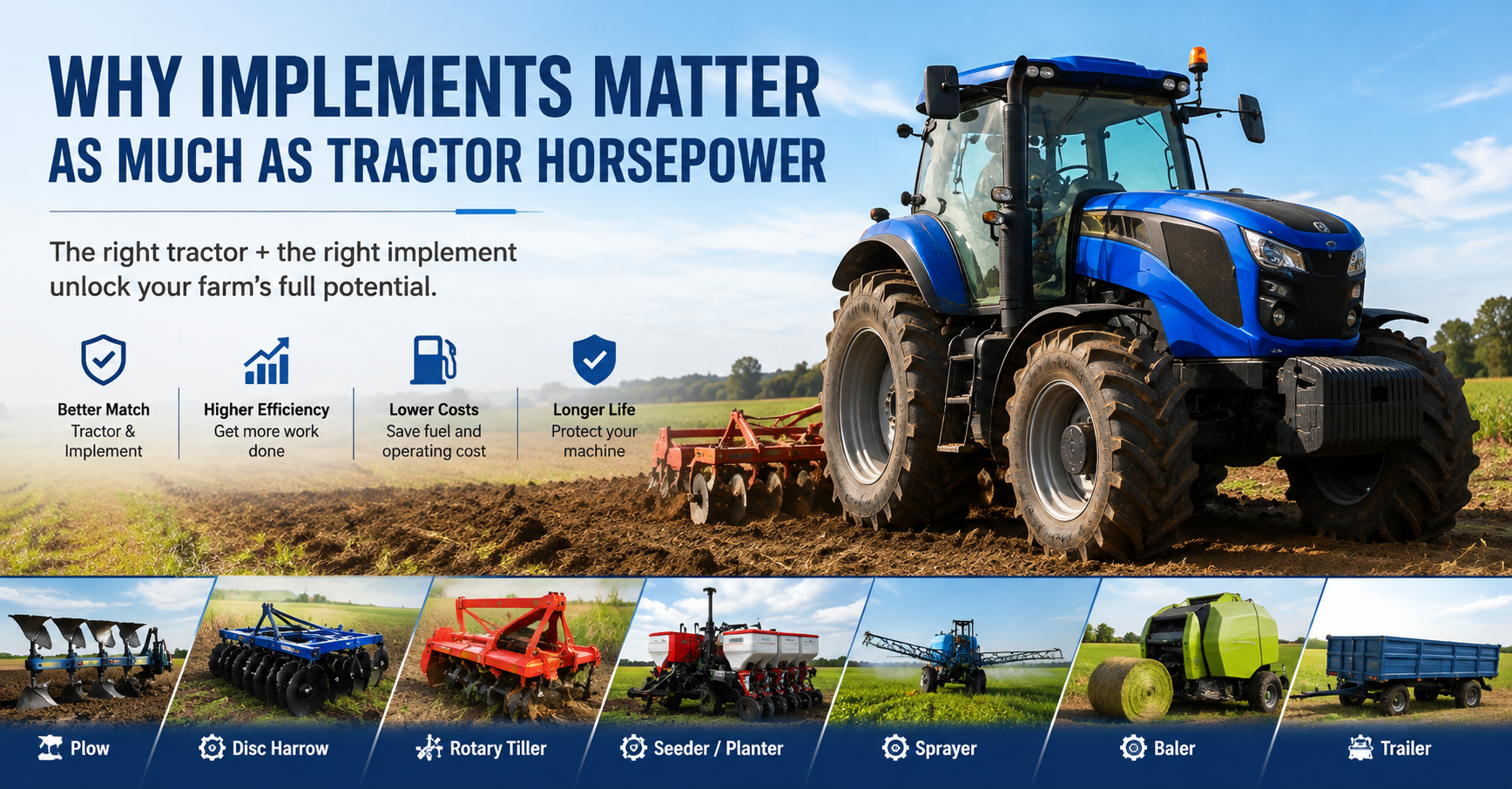
Horsepower is important, but it is not the only factor when selecting a tractor. A machine with high engine power may still be unsuitable if its hitch, PTO, hydraulics, tire setup, or lift capacity does not match the intended implements.
Before choosing a tractor, evaluate:
Factor | Why It Matters |
Engine and PTO power | Determines whether the tractor can operate demanding implements effectively |
Drive type | 4WD improves traction in soft soil, slopes, and heavy pulling work |
Hydraulic flow and pressure | Affects loader response and hydraulic implement performance |
Three-point hitch category | Must be compatible with mounted implements |
Lift capacity | Determines the weight of equipment the tractor can safely carry |
Tractor weight and wheelbase | Influences stability, traction, and ride quality |
Tire or track configuration | Should suit the soil, crop system, and terrain |
Cab and operator features | Improve comfort and productivity during long working hours |
For example, a rotary mower may require sufficient PTO power, while a front loader depends heavily on hydraulic performance and proper rear ballast. A plow requires traction and drawbar force, while a precision planter needs stable speed and accurate implement control.
The best tractor is not automatically the largest model. It is the one that can complete the farm’s regular and most demanding tasks efficiently, safely, and within the available working window.
Start by defining:
1. Your main jobs: Tillage, planting, spraying, mowing, loader work, hauling, or a combination.
2. Your farm size: Smaller plots may need a compact and maneuverable machine, while larger farms may require more power and working width.
3. Your terrain: Slopes, wet fields, rough roads, orchards, and narrow rows all affect the best tractor configuration.
4. Your implements: Check PTO, hitch, hydraulic, electrical, and weight requirements.
5. Your future needs: A tractor should have enough capacity for planned attachments and business growth.
6. Service and parts support: Reliable maintenance support helps protect uptime during critical seasons.
For demanding fieldwork, a 4WD tractor can provide stronger traction and greater stability. Agrotianda’s 120HP 4WD agriculture tractor is designed for heavy-duty farming and landscaping applications where power, implement compatibility, and reliable operation are essential.
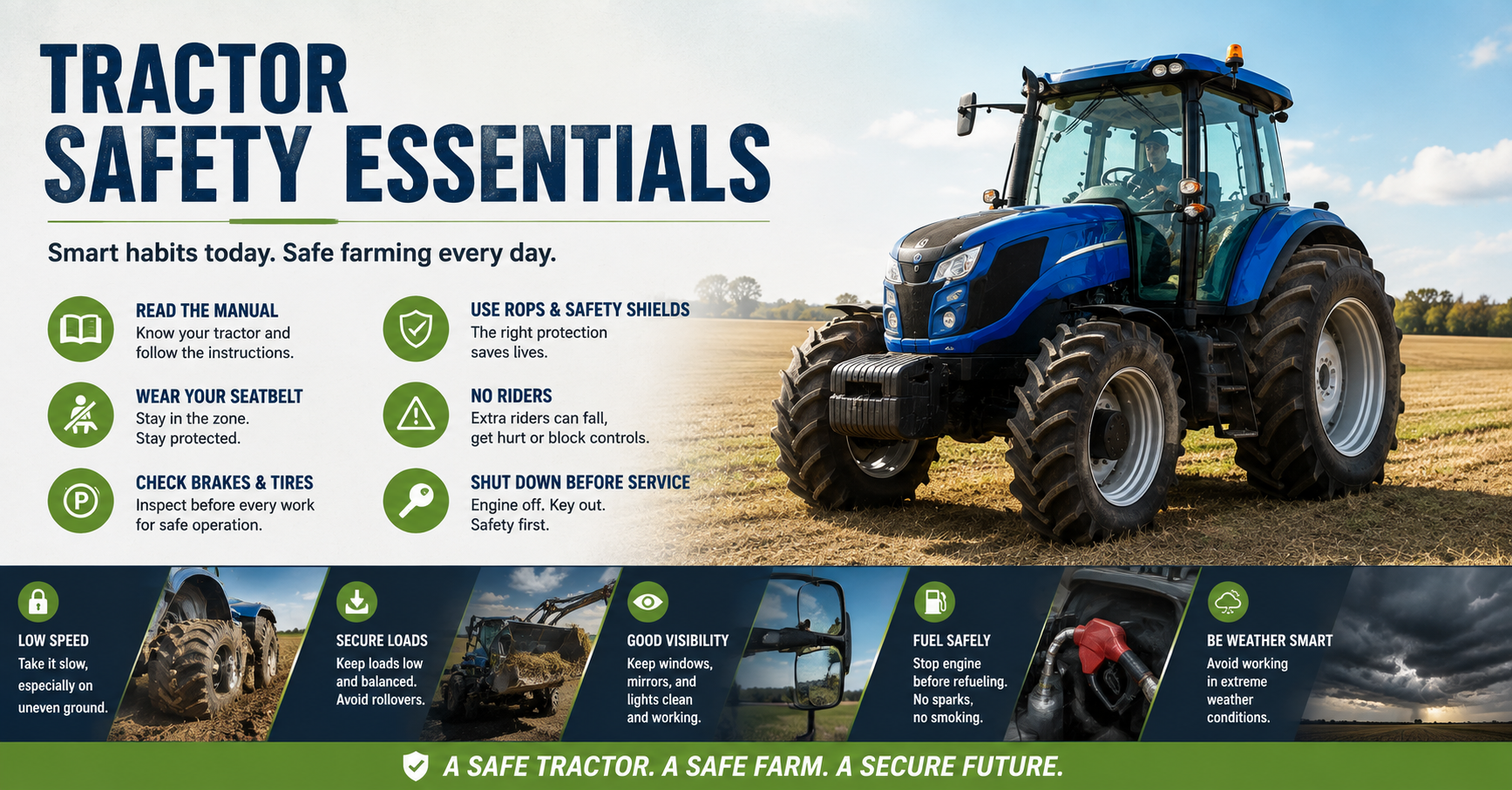
Tractors are powerful machines, so safe operation should always be part of daily farm management.
Key safety practices include:
Read the operator manual before using a new tractor or attachment.
Use the seat belt when the tractor is equipped with rollover protection.
Keep PTO shields and all guards in place.
Add proper ballast before loader or heavy rear-implement work.
Keep loads low while traveling to improve stability.
Avoid turning sharply on slopes or uneven ground.
Check tires, brakes, hydraulic hoses, lights, and hitch pins regularly.
Never allow extra riders unless the tractor has an approved passenger seat.
Shut down the engine and disconnect power before servicing implements.
A good maintenance routine also improves machine life. Regular checks of engine oil, coolant, filters, transmission fluid, tire pressure, and hydraulic connections can reduce unexpected downtime.
So, what does a tractor do? It provides the power, traction, lifting ability, and implement control needed to complete work across the agricultural cycle. It prepares soil, supports planting, manages crops, powers equipment, transports materials, and assists with harvest and farm maintenance.
Its real value comes from versatility. When the tractor, implements, terrain, and workload are properly matched, one machine can support a wide range of productive jobs throughout the year. Explore Agrotianda’s agricultural machinery solutions to find equipment suited to modern farm operations.
The main purpose of a tractor is to provide pulling power, PTO power, hydraulic control, and lifting capacity for agricultural implements and farm tasks.
Yes. With suitable attachments, tractors can handle loader work, hauling, road maintenance, mowing, livestock tasks, material handling, and many other jobs.
Engine horsepower measures total engine output. PTO horsepower measures the usable power delivered to PTO-driven implements, so it is especially important when selecting mowers, balers, tillers, and similar equipment.
Not for every farm, but 4WD is valuable for heavy tillage, wet or loose soil, slopes, loader work, and situations where stronger traction is needed.
Choose based on your hardest regular task, required implements, field conditions, desired working speed, and future needs—not only on engine horsepower.


