Views: 0 Author: Site Editor Publish Time: 2026-09-01 Origin: Site
The best farm tractor for the money is not necessarily the cheapest model or the one with the highest horsepower. It is the tractor that completes your regular work safely, matches your implements, and keeps ownership costs under control over many seasons.
For many mixed farms, a 50–90 HP 4WD utility tractor offers the strongest balance of price, versatility, traction, and implement compatibility. However, the right choice ultimately depends on your land, crops, terrain, workload, and local service needs.
A tractor’s purchase price is only one part of its cost. A low-priced machine can become expensive if it lacks the power, hydraulic capacity, traction, or support needed for daily work. On the other hand, buying far more tractor than the farm requires can increase fuel consumption, maintenance, tire costs, and soil compaction.
The best-value tractor should deliver:
Enough power for the farm’s heaviest regular task
Suitable PTO output for powered implements
Hydraulic capacity for loaders and attachments
Adequate weight and traction for the terrain
Safe, comfortable operation during long workdays
Reliable parts and technical support
Flexibility for realistic future growth
Think of value as cost per productive hour rather than the number on the quotation. A tractor that finishes fieldwork on time, handles several implements, and avoids costly downtime can be a better investment than a cheaper machine with limited capability.
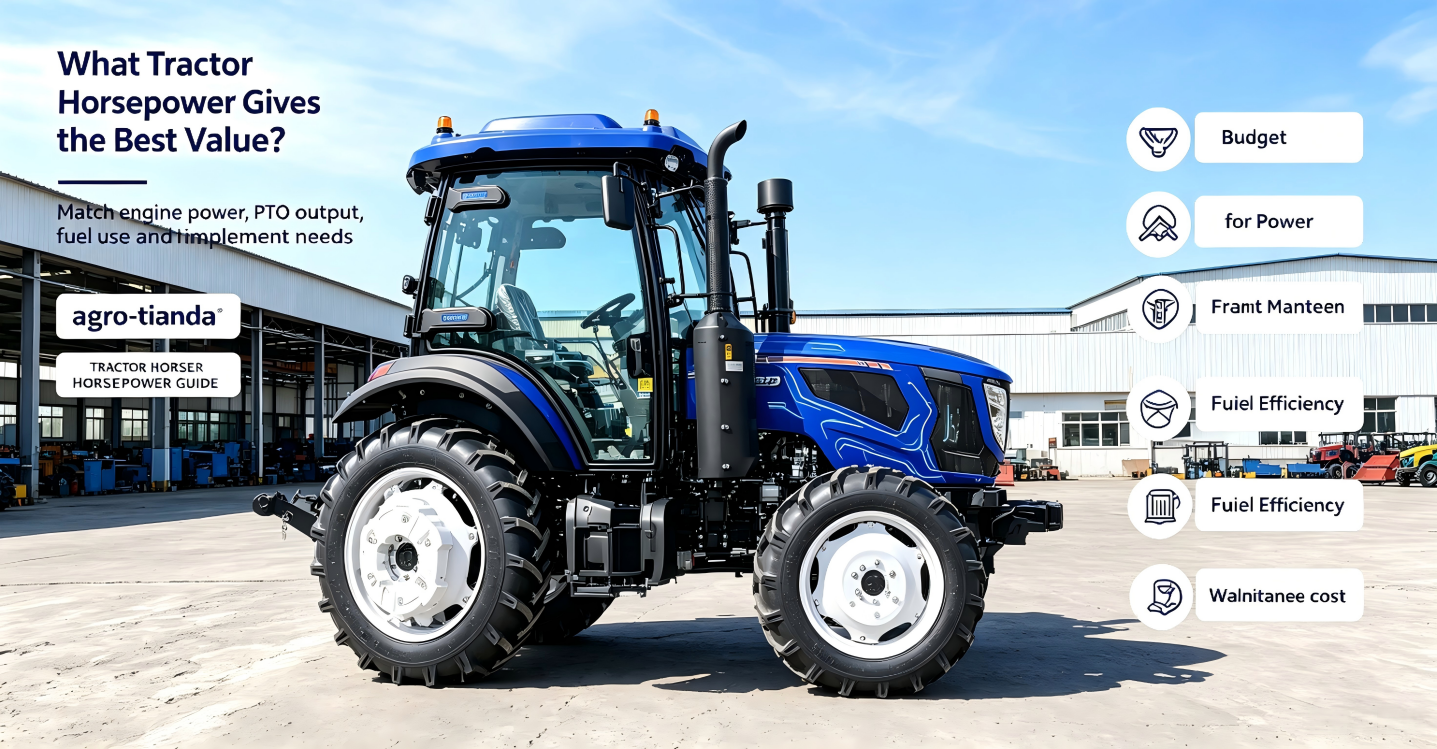
Horsepower should be matched to work requirements, not selected by acreage alone. Field shape, soil condition, slopes, crop type, implement width, and seasonal workload all affect the answer.
Farm situation | Typical horsepower range | Common work |
Small property, orchard, garden | 20–40 HP | Mowing, spraying, light cultivation, small trailers |
Mixed farm or livestock operation | 50–90 HP | Loader work, hay handling, tillage, planting, transport |
Larger field farm | 100–150 HP | Heavy tillage, larger planters, hauling, high-capacity implements |
Large commercial operation | 150 HP and above | Wide implements, sustained draft work, intensive field operations |
For many buyers, the 50–90 HP category is the practical “sweet spot.” It is large enough to handle demanding farm jobs yet compact enough for general-purpose work, yard access, transport, and efficient operation. A well-configured tractor in this range can support mowing, plowing, seeding, material handling, farm transport, and a wide range of PTO-driven equipment.
Before selecting a machine, list the heaviest implement you will use. Check its required PTO power, hitch category, weight, hydraulic requirements, and recommended tractor size. Engine horsepower alone does not guarantee that a tractor can operate an attachment effectively.
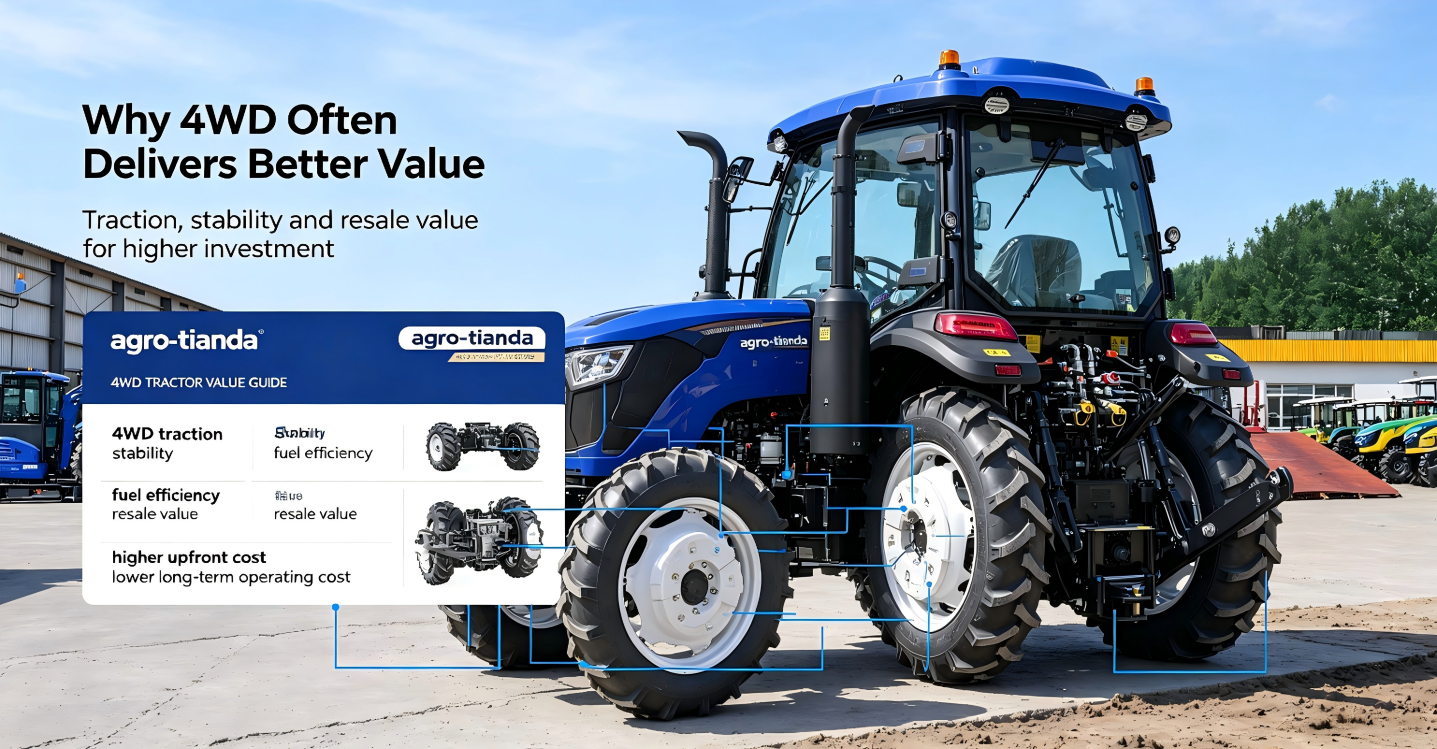
Four-wheel drive can cost more initially, but it often pays for itself where traction matters. On wet ground, slopes, loose soil, or uneven fields, 4WD helps transfer engine power into useful pulling force. It can reduce wheel slip and improve steering control when using a front loader or pulling heavy implements.
A 2WD tractor may still be a sensible value choice for light work on firm, flat land. It has a simpler front axle and may cost less to buy and maintain. But for farms that regularly work in changing field conditions, handle loaders, or need dependable traction during short planting and harvesting windows, 4WD is usually the better long-term decision.
The key is to avoid treating 4WD as a replacement for safe operating practices. Correct ballast, suitable tires, stable load handling, a protective structure, and seat-belt use remain essential.
A good value tractor is a complete working system. Buyers should compare the specifications that directly affect attachment performance and daily productivity.
PTO horsepower indicates how much usable power reaches implements such as rotary mowers, tillers, balers, sprayers, and grain-handling equipment. If a powered implement has a minimum PTO requirement, ensure the tractor can meet it with a safe working margin.
Hydraulic flow and valve capacity are especially important for front loaders, hydraulic trailers, balers, grapples, and other attachments. A tractor may have adequate engine power but still feel slow or limited if its hydraulic system cannot support the work.
Check the hitch category and rated lift capacity at the proper measurement point. The tractor must safely lift and control the implements you own or plan to purchase. Do not judge capability by appearance alone.
Loader work benefits from smooth shuttle shifting and practical forward-reverse control. Fieldwork benefits from gear ratios that let the operator maintain the correct working speed. The best transmission is the one that fits the job, not necessarily the one with the longest feature list.
Tire type affects traction, flotation, crop damage, and performance in mud or paddy conditions. Tractor weight affects pulling capacity and stability, but excessive weight can compact soil and make maneuvering difficult. Measure gate openings, row spacing, storage height, bridge limits, and transport routes before ordering.
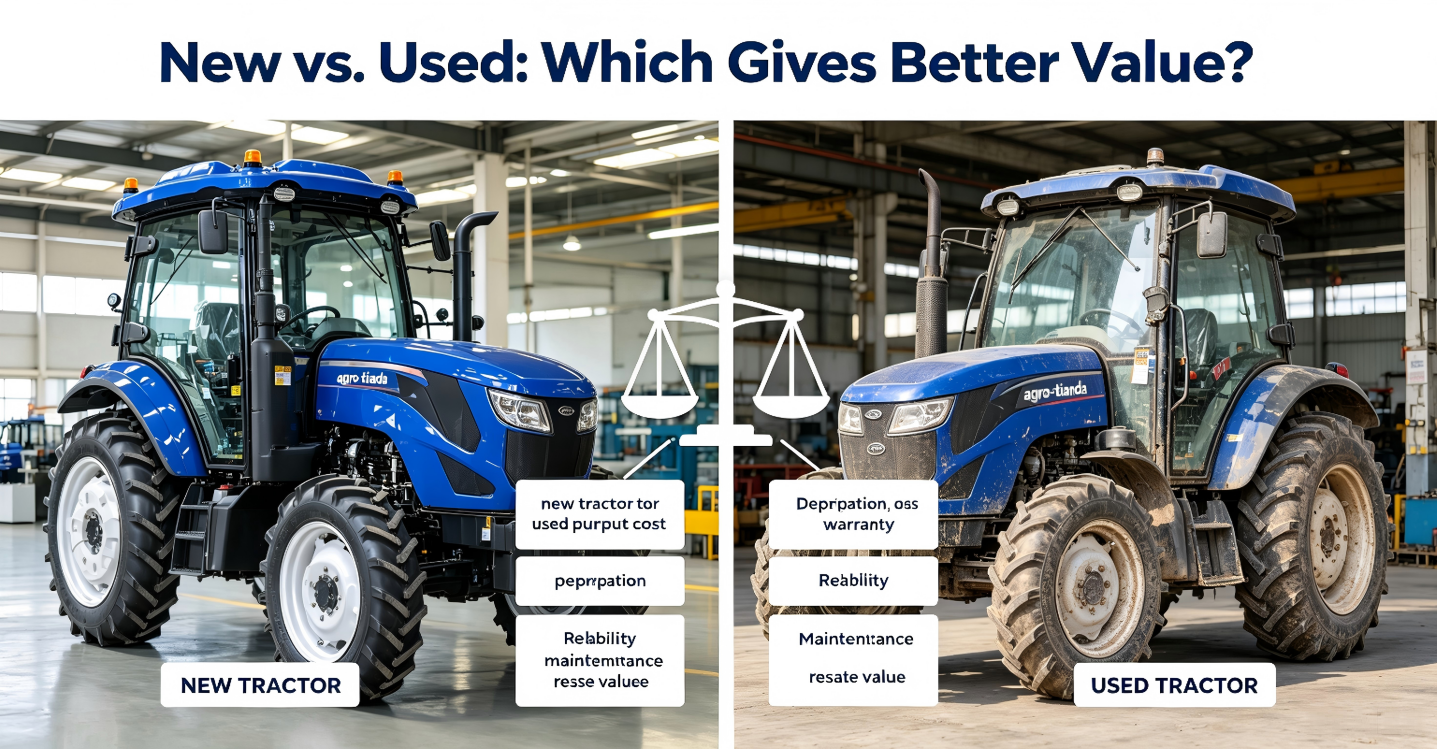
A used tractor can offer excellent value when its service history is known, the machine has been inspected carefully, and parts are available locally. It may allow buyers to invest more in essential implements instead of spending the full budget on the tractor itself.
However, a used machine with hidden wear, poor maintenance, unsupported components, or no reliable parts source can quickly consume its initial savings. Buyers should inspect engine performance, hydraulics, PTO operation, transmission behavior, tires, leaks, steering, brakes, and attachment points. Maintenance records and a real operating test are more useful than a clean paint finish.
A new tractor is often the better choice when the farm depends on reliable seasonal capacity, needs a specific configuration, or requires warranty protection. It also provides the chance to match tires, cab options, hydraulics, transmission, and attachments to local conditions from the beginning.
The best farm tractor for the money is the one with the lowest acceptable lifetime cost for the work it performs. Compare each option using the same checklist:
Tractor price and included equipment
Freight, insurance, duties, and local delivery charges
Loader, ballast, tires, cab, and attachment costs
Fuel consumption for expected work
Scheduled service, filters, fluids, and tires
Warranty coverage and exclusions
Parts availability and expected response time
Operator training and technical support
Resale value and expected productive life
Downtime risk during critical field windows
A practical comparison formula is:
Estimated lifetime ownership and operating cost ÷ expected productive hours = cost per productive hour
Then compare that result with the area cultivated, loads moved, labor saved, or work completed each season. This approach prevents a low initial price from hiding a high cost of operation.
For a diversified operation with regular loader work, tillage, mowing, transport, and moderate-acreage field tasks, a 50–90 HP 4WD utility tractor is often the best farm tractor for the money. It provides useful reserve power without the higher purchase and operating costs of a large field tractor.
Farmers with narrow rows, orchard access, or small properties may get better value from a smaller, maneuverable machine. Farms with wide implements, heavy draft work, or demanding schedules may need 100 HP or more to finish work efficiently.
Agrotianda’s tractor range covers utility and heavy-duty applications, with configurations from 50 HP to 240 HP. For a buyer whose work profile fits the utility category, a 50 HP 4WD farm tractor with cabin can be a useful starting point for evaluating power, traction, operator comfort, and implement needs.
The best farm tractor for the money is the one that matches your real work—not the largest or lowest-priced machine available. Start with your heaviest implement, field conditions, annual hours, and support requirements. Then compare PTO performance, hydraulics, hitch capacity, traction, operating costs, and service support.
For many farms, a properly equipped 50–90 HP 4WD utility tractor delivers the strongest combination of capability and long-term value. Choose a configuration that works hard today while leaving room for realistic growth tomorrow.
For many mixed farms, a 50–90 HP 4WD utility tractor offers excellent value because it can handle loaders, PTO implements, transport, and moderate fieldwork without the ownership cost of a larger tractor.
Usually, yes, when work includes slopes, mud, loose soil, front-loader duties, or heavy draft implements. For light work on level, firm ground, a 2WD tractor may be sufficient.
Small farms often need 20–50 HP, depending on the heaviest implement and the type of work. A small acreage with difficult terrain or demanding attachments may need more power than a larger, level property.
For PTO-driven implements, PTO horsepower is essential because it reflects usable power delivered to the attachment. Buyers should still consider engine horsepower, hydraulics, weight, and hitch capacity together.
Buy used when the tractor has a verifiable service history, passes a thorough inspection, and has dependable parts support. Choose new when uptime, warranty coverage, custom configuration, and predictable operating costs are priorities.
Request a model-specific specification sheet showing engine and PTO ratings, hydraulics, hitch capacity, tire type, 4WD configuration, included equipment, warranty, parts support, delivery terms, and total delivered cost.