

Views: 0 Author: Site Editor Publish Time: 2026-08-18 Origin: Site
A tractor can be too powerful and still be a poor purchase. Extra size raises costs, while insufficient power delays essential fieldwork.
So, what is the best farm tractor to buy? It is the machine matching your hardest regular job, terrain, implements, and support needs.
This guide explains 4WD value, horsepower, PTO output, hydraulics, operator features, and lifetime cost. You will also get a practical comparison method before requesting quotations.
The best farm tractor is not automatically the largest or cheapest model. It should complete recurring tasks safely during your available working window. It also needs enough reserve capacity for difficult soil, slopes, and future implements.
Build a work profile before comparing brochures or tractor brands. Record your heaviest implement, busiest season, annual hours, loader duties, and road travel. Include row spacing, gate width, storage height, soil condition, and likely farm expansion.
Operating profile | Broad power starting point | Typical work | Main buying risk |
Orchard / small property | 20–40 HP | Mowing, light tillage, spraying | Excess width or weak implement capacity |
Mixed / diversified farm | 40–100 HP | Plowing, baling, hauling, loader work | Insufficient PTO or hydraulic output |
Commercial field operation | 100–175 HP | Heavy tillage, planting, large transport | Excess weight or operating cost |
Large-scale heavy work | 175+ HP | Wide implements and sustained draft | Paying for unused capacity |
These ranges are only screening tools. Ten wet, steep hectares can demand more traction than larger, level acreage. A baler, planter, or loader may determine tractor size more accurately than farm area.
Agrotianda presents a configurable 4WD farm tractor range covering utility through high-power applications. Its site states more than 20 years of equipment experience and relationships across 30-plus countries. Published choices include different engines, tire types, colors, and 50–240HP custom configurations.
Start with each implement manufacturer’s minimum PTO power, hydraulic flow, hitch category, and tractor-weight guidance. Then add a reasonable working margin agreed with the equipment supplier. Do not substitute engine horsepower for those separate requirements.
Finally, rank your needs as essential, useful, or optional. Four-wheel drive may be essential on slopes but optional for light hauling. A cab can become essential during long, dusty, hot, or cold shifts.
A four-wheel-drive farm tractor sends usable force through both axles. This usually improves traction on mud, loose soil, slopes, and uneven ground. It can also reduce wasted wheel slip during demanding draft work.
However, 4WD does not create additional engine power. It helps transfer available power into movement more effectively. Benefits depend on correct tires, inflation, ballast, weight distribution, and implement setup.
Condition or task | 4WD tractor | 2WD tractor |
Mud, slopes, or loose soil | Better traction and steering authority | Higher risk of slip or lost momentum |
Front-loader work | Better pulling grip under changing axle loads | Suitable only for lighter, favorable work |
Heavy tillage | Uses available power more effectively | May require more ballast or better conditions |
Light mowing and firm-ground hauling | Capable, but costs more initially | Often the economical choice |
Maintenance | More driveline components | Simpler front axle and lower initial cost |
Loader work makes the 4WD decision especially important. A loaded bucket changes axle weight and can reduce rear traction. Four driven wheels help the tractor move and steer, although approved rear ballast remains essential.
The best 4WD tractor for farming should be judged by completed work, not purchase price alone. Finishing tillage before rain may protect far more value than the drivetrain premium. Reliable movement can also reduce recovery time when conditions deteriorate.
Conversely, 2WD may deliver better value for light hay work or transport. Firm, level ground reduces the need for extra driven components. A buyer should compare actual annual 4WD tasks before paying for unused capability.
Never treat 4WD as a safety guarantee. It does not cancel rollover risk, stopping distance, or slope limits. Use an approved protective structure, seat belt, correct ballast, and manufacturer operating guidance.
Engine horsepower attracts attention, but it does not describe the complete working system. PTO horsepower shows how much power reaches driven implements. Hydraulic flow determines whether cylinders and motors move properly under load.
The University of Wisconsin’s tractor pre-purchase examples show why this distinction matters. One baler can set both PTO and hydraulic minimums. Meeting only one specification still leaves an incompatible tractor.
Feature | What to verify | Why it affects value |
PTO output and speeds | Rated PTO HP; 540, 540E, or 1,000 rpm | Determines driven-implement compatibility |
Hydraulic system | Pump flow, pressure, valve count, couplers | Controls loaders, balers, and hydraulic motors |
Three-point hitch | Category, lift capacity, control modes | Prevents unsafe or unusable implement matches |
Transmission | Gear spacing, shuttle, creeper, or powershift | Matches speed to tillage, loader, and transport work |
Tires and clearance | Tread, width, load rating, crop clearance | Changes traction, compaction, and crop access |
Safety and comfort | ROPS or cab, belt, brakes, visibility, seat | Supports safer work and longer productive shifts |
A farm tractor with front loader needs suitable hydraulic capacity and axle ratings. It also needs a compatible mounting frame, counterweight plan, and useful reverse gearing. Bucket size alone says little about safe lift performance.
Transmission choice should match operator skill and duty cycle. Shuttle functions help repeated forward-reverse loader work. Multiple close gear ratios help maintain suitable field speed under changing loads.
Cab comfort becomes an economic feature during long seasons. Reduced dust, noise, heat, and fatigue can support consistent operation. Yet a cab adds height, weight, glass, climate components, and repair cost.
Ask suppliers for one signed, model-specific specification sheet. Product-family tables sometimes combine several configurations. The order should identify engine model, PTO rating, hydraulic flow, axle limits, tires, hitch, safety equipment, and included tools.
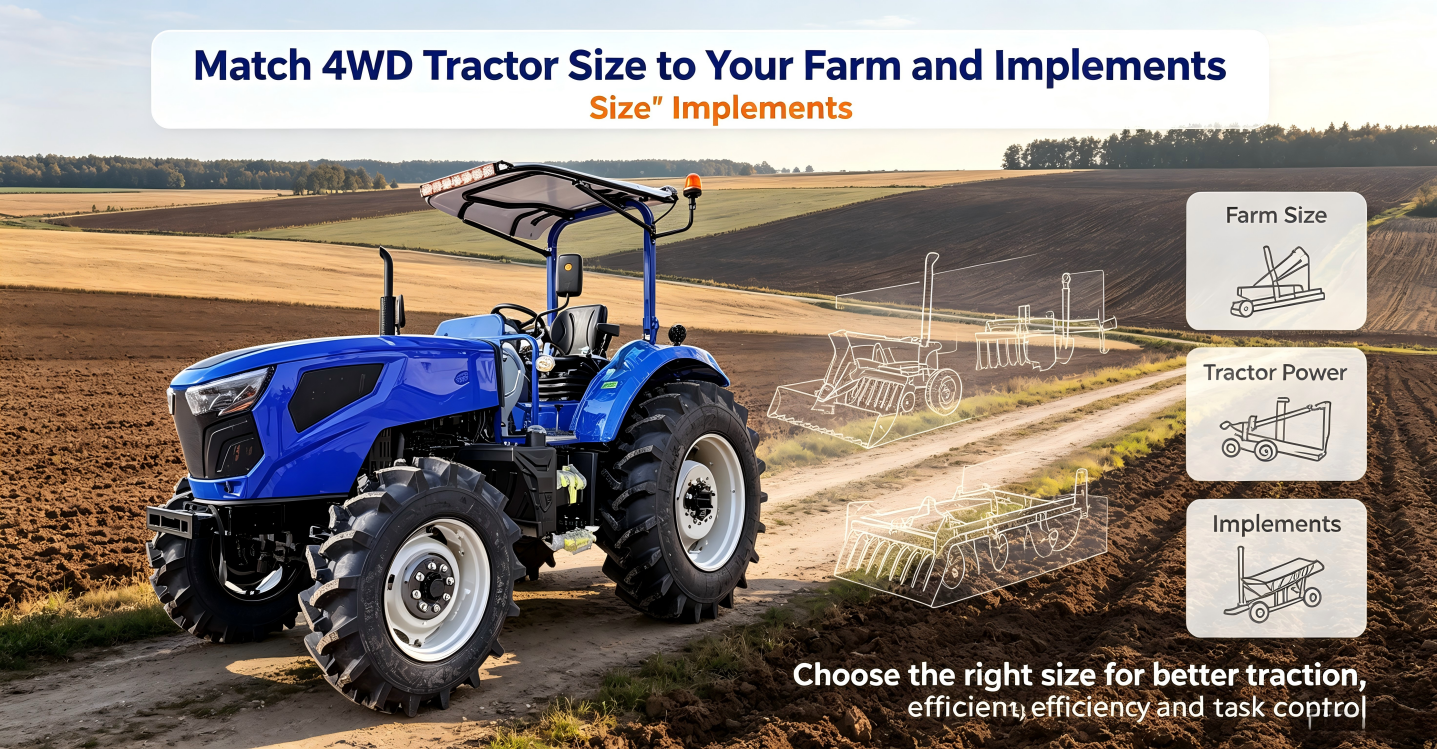
Farm size affects required field capacity, but acres never tell the full story. Soil resistance, field shape, weather, travel distance, and implement width change the answer. Narrow orchards may favor compact dimensions despite demanding slopes.
Tractor class | Best-fit situations | Features to prioritize |
Compact or light utility | Orchards, gardens, mowing, narrow access | Turning radius, low weight, visibility, tire choice |
Utility, about 40–100 HP | Mixed farms, livestock, hay, general loader work | PTO output, shuttle transmission, hydraulics, cab options |
Heavy utility, about 100–175 HP | Larger tillage, planting, hauling, heavy loaders | Tractor weight, lift capacity, gearing, cooling |
High horsepower | Wide implements and large commercial fields | Drawbar capacity, ballast, fuel use, transport dimensions |
Agrotianda’s public pages show 4WD examples from a 40HP open-frame tractor through 75HP, 90HP, 100HP, 120HP, and 150HP machines. Higher-power enclosed-cab configurations also appear in its catalog. Its farm tractor horsepower guide groups compact, utility, and heavy-duty uses by workload.
An undersized tractor may travel too slowly, overheat, or operate near maximum load continuously. It can miss short planting or harvest windows. Heavy implements may also exceed safe hitch, axle, or braking capacity.
Oversizing creates different problems. Purchase price, fuel, tires, storage, and transport needs can rise. Extra weight may increase soil compaction or make headland turns awkward.
Compare two future scenarios before selecting. First, model current work during the busiest week. Then add realistic expansion, one larger implement, or new loader duties.
Also measure turning radius, overall width, transport height, axle loads, and legal road limits. Strong field power can still become impractical between fields. Storage doors, bridges, trailers, and narrow lanes often expose that mismatch.
Choose capacity supporting likely growth without buying speculative power. A well-matched utility tractor often provides better value than an impressive machine working lightly. Productive utilization pays for equipment; parked horsepower does not.
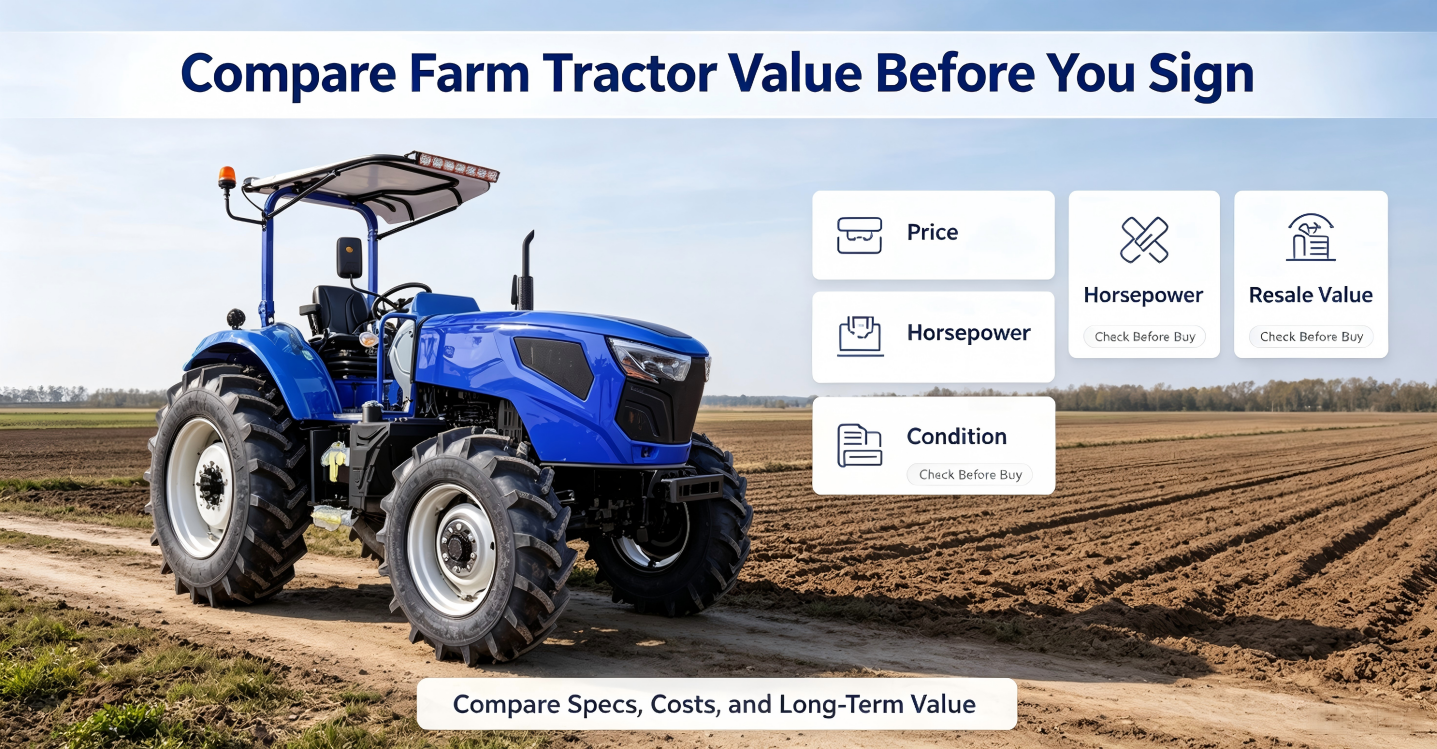
Purchase price is only the first line in a tractor’s cost. Ownership includes depreciation, finance, insurance, taxes, and storage. Operating costs include fuel, labor, maintenance, repairs, tires, and avoidable downtime.
Iowa State University Extension provides an estimating farm machinery costs framework for these categories. Your figures will differ by country and operation. The useful method remains comparing complete ownership and operating costs.
Use this simple decision measure:
Estimated lifetime cost ÷ expected productive hours = cost per productive hour
Then test the result against hectares completed, loads moved, or labor replaced. Include freight, duties, commissioning, implements, and required options in every quotation. A low factory figure may become expensive after missing equipment is added.
RFQ line | Required detail |
Exact tractor | Model, year, engine, emissions configuration, 4WD system |
Working outputs | PTO HP and speeds, hydraulic flow, valves, hitch capacity |
Included equipment | Tires, ballast, cab, loader, drawbar, tools, spare filters |
Delivered cost | Machine, packing, freight, insurance, duties, local charges |
Support | Warranty scope, response method, parts prices, manuals, training |
Acceptance | Inspection points, test records, defect remedy, delivery schedule |
Agrotianda states a 12-month warranty, later technical support, and continued original-parts supply. Its website also lists one-unit orders, 20–30-day production after deposit, and several customization choices. Buyers should reconfirm every term, specification, certification, and remedy inside the signed quotation.
Request maintenance schedules, parts lists, test records, and reference installations in similar conditions. Confirm fuel quality, lubricants, filters, and diagnostic support available locally. Estimate downtime during your most valuable seasonal window.
The best value farm tractor is rarely the lowest bid. It is the configuration completing required work at acceptable lifetime cost and risk. A clear comparison sheet makes that difference visible before money changes hands.
The best farm tractor to buy is a matched working system, not one famous model. Size it from implements, terrain, field windows, and support requirements.
4WD often earns its premium through traction, loader control, and difficult-weather productivity. Compare signed specifications and lifetime cost before choosing. That process reveals real value far better than horsepower or price alone.
A: Match implements, terrain, workload, support, and lifetime cost.
A: Usually for loaders, slopes, mud, and heavy draft work.
A: Often 20–50 HP; verify the heaviest implement first.
A: For powered implements, yes; both ratings still matter.
A: Request exact outputs, delivered cost, warranty, parts, and tests.


