

Views: 0 Author: Site Editor Publish Time: 2026-05-22 Origin: Site
Buying a farm tractor is one of the biggest money choices that will ever have to be made by a farm business. A lot of buyers find themselves trying to balance the amount of money they have to spend with the amount of horsepower that they need. A tractor with too much power can result in a large initial cost and high fuel usage, yet one buys too little power will cause downtime at best, excessive equipment wear and lost work at worst.
To maximize your return on investment (ROI), make sure the horsepower rating (HP) of the tractor you buy matches your farm's size and terrain as well as the specific implements you'll use. This guide provides an overview of all the different horsepower segments for tractors, and will help you decide on the best configuration for your farm.
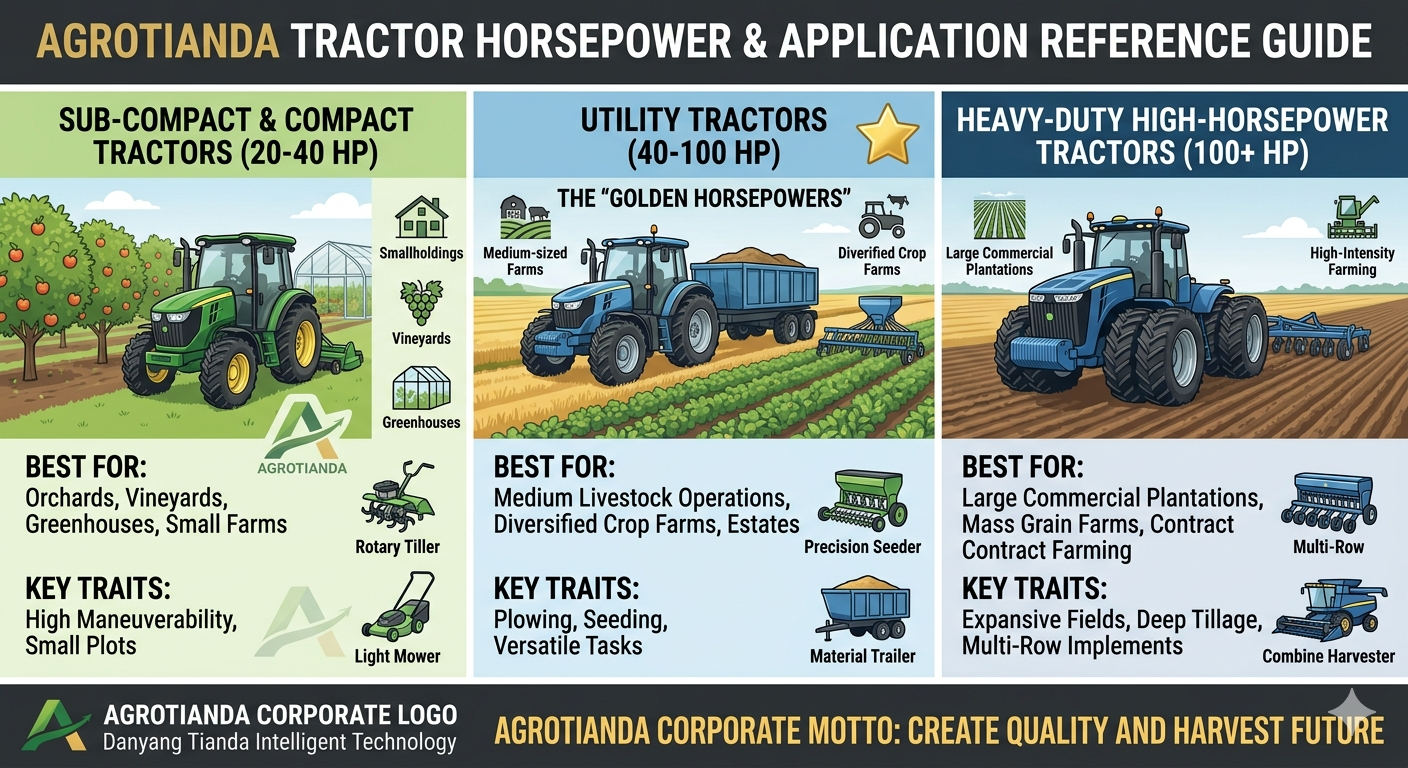
Tractors are generally categorized by their horsepower, which dictates their frame size, weight, and operational capabilities.
Best For: Smallholdings, orchards, vineyards, greenhouses, and large residential landscaping.
Key Traits: High maneuverability in tight rows, lightweight frames that minimize soil compaction, and lower fuel consumption. They are ideal for pulling small utility trailers, light mowers, and rotary tillers.
Best For: Medium-sized livestock operations, diversified crop farms, and managed estates.
Key Traits: The "golden horsepowers" of farming. These versatile machines have the structural weight and hydraulic capacity to manage heavy-duty agricultural tasks, including deep plowing, uniform seeding, row weeding, and pulling heavy-duty material transport trailers.
Best For: Large-scale commercial plantations, massive grain farms, and rugged contract farming operations.
Key Traits: Engineered for high-intensity, continuous operations across expansive fields. They provide the extreme traction and Power Take-Off (PTO) output required to pull multi-row seed drills, massive combine harvesters, and heavy deep-tillage plows over thousands of hectares.
Before finalizing a specification sheet, evaluate these four critical operational variables:
A flat, 10-hectare vegetable farm requires significantly less power than a 10-hectare hilly orchard. Driving up steep slopes, navigating muddy rice paddies, or working on sandy soils consumes substantial engine power just for basic locomotion. For challenging or waterlogged terrains, ensure your horsepower selection accounts for a "power reserve" to handle unexpected traction loss.
A tractor is only as useful as the tools it powers. Every mechanical implement—whether a precision transplanter, a rotary cutter, or a mini excavator attachment—has a minimum PTO horsepower requirement. Always check the specifications of your heaviest or most critical implement and choose a tractor whose PTO rating exceeds that requirement by at least 10–15%.
While legacy global brands carry high recognition, they often come with steep brand premiums that do not necessarily translate to a higher ROI for mid-sized or growing farming operations. High-quality, modern agricultural machinery manufacturers now offer comparable durability, advanced digital integration, and heavy-duty performance at a fraction of the cost, making them a much more economically viable option.
Choosing the right horsepower is only the first step. To guarantee long-term field reliability, consider the following value-added factors when selecting a machinery partner:
Tailored Configurations: Opt for a supplier that offers flexible customized engineering. Being able to adapt a 50HP or 100HP tractor with specific tire profiles, hydraulic outputs, or specialized features ensures the machine fits your exact crop requirements.
After-Sales Support Ecosystem: A tractor standing still in the field during harvest costs money every hour. Ensure your manufacturer provides a robust warranty, long-term guaranteed availability of spare parts, and immediate online messaging or video technical support to resolve maintenance queries instantly.
Complimentary Wearing Parts: High-value manufacturers often include a complimentary package of critical wearing parts with tractor purchases, reducing your immediate maintenance overhead.
Selecting the right tractor horsepower is a strategic calculation that balances your current field requirements with your long-term growth objectives. By matching the horsepower to your specific terrain and implement needs, you ensure your farm operates at peak efficiency with minimized fuel costs.
At Agrotianda (Danyang Tianda Intelligent Technology), we bring over twenty years of manufacturing experience to help farmers worldwide optimize their operations. Guided by our corporate motto, "Create quality and harvest future," we provide a highly cost-effective, diverse lineup of tractors and farm machinery tailored to your unique conditions.
Need a Tailored Recommendation? Contact our expert technical team today via online messaging or video consultation to configure the perfect horsepower and implement setup for your farm.


