

Views: 0 Author: Site Editor Publish Time: 2026-08-27 Origin: Site
If you grow rice in India, you already know that harvesting is not simply a matter of cutting the crop.
When your paddy is ready, you have a limited window to get the job done. Your field may still be wet. The soil may be soft or muddy. Some rice plants may have lodged after wind or rain. At the same time, finding enough workers during the peak harvesting season can be difficult and expensive.
This is where the right paddy harvester in India can make a real difference.
A modern combine harvester can cut, thresh, separate, clean, and collect grain in one operation. But choosing the right machine for your farm requires more than looking at horsepower or price.
You need to consider your field conditions, crop type, harvesting area, machine configuration, working capacity, grain loss, maintenance, and after-sales support.
In this guide, we will walk you through the key factors you should consider before buying a paddy harvesting machine for Indian rice fields.
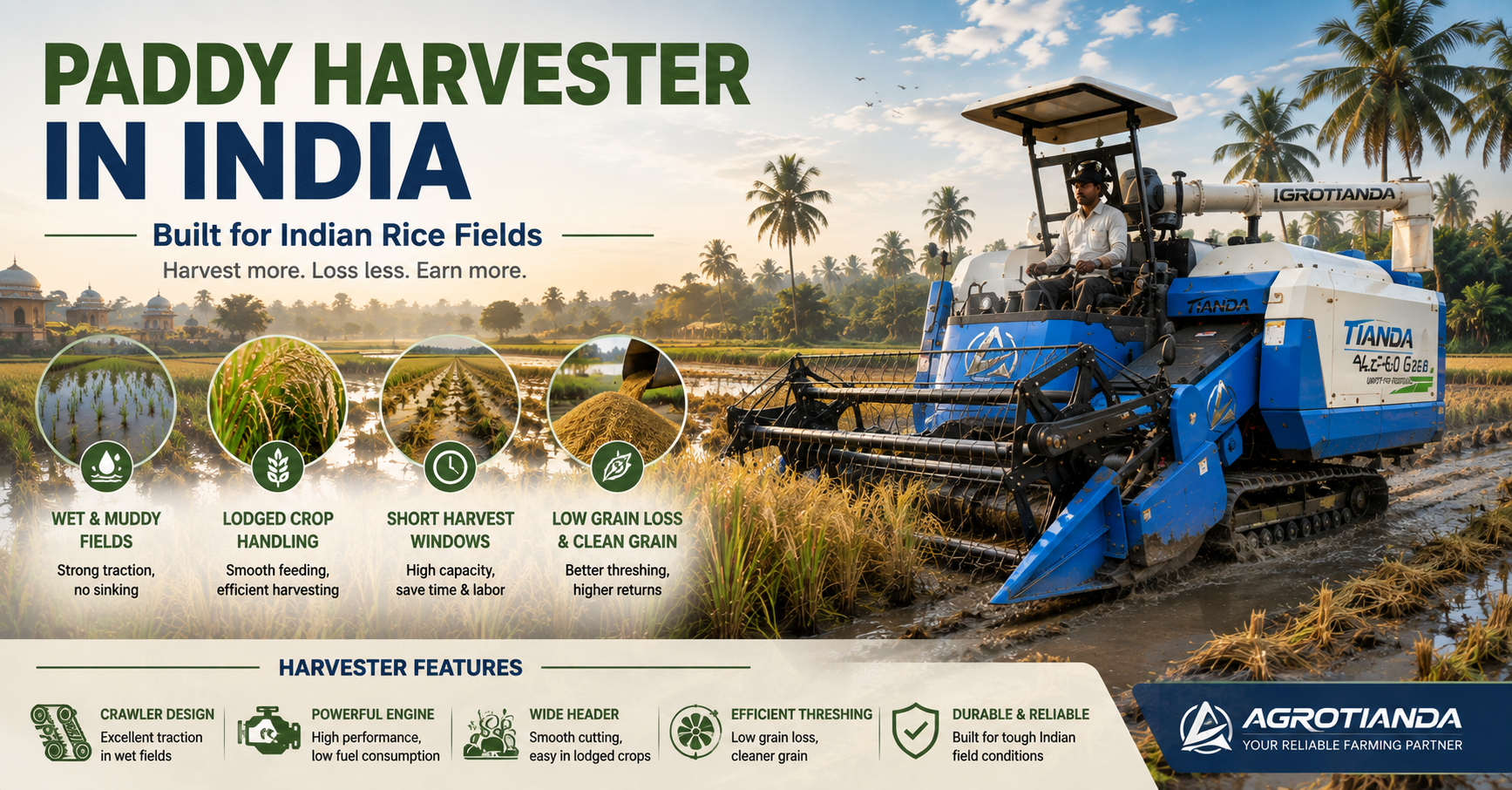
Rice is one of India's most important food crops, and millions of farmers depend on efficient harvesting to protect both yield and income.
The challenge is that harvesting often needs to be completed within a short period. If your crop stays in the field for too long after reaching maturity, weather conditions can increase the risk of grain loss and quality problems.
Labor availability is another important consideration.
The Indian Council of Agricultural Research has highlighted the importance of agricultural mechanization in addressing labor shortages and improving the efficiency of farming operations.
For you as a farmer or agricultural contractor, the calculation is straightforward:
The faster and more efficiently you can harvest your crop, the easier it is to manage your harvesting schedule and control labor costs.
That is why a reliable rice harvesting machine is becoming increasingly important in modern Indian agriculture.
A paddy harvester is a machine designed to harvest mature rice efficiently.
A modern paddy combine harvester can perform several operations during a single pass through the field:
Cutting → Feeding → Threshing → Separation → Cleaning → Grain Collection
Instead of cutting the rice manually and then transporting it somewhere else for threshing, a combine harvester handles these processes continuously.
This saves time and reduces the amount of manual handling required after harvesting.
However, you should remember that not every combine harvester is equally suitable for paddy.
A machine designed mainly for dry wheat fields may not perform as well in deep mud or soft rice fields. This is why field conditions should be one of the first things you consider when choosing a paddy harvester in India.
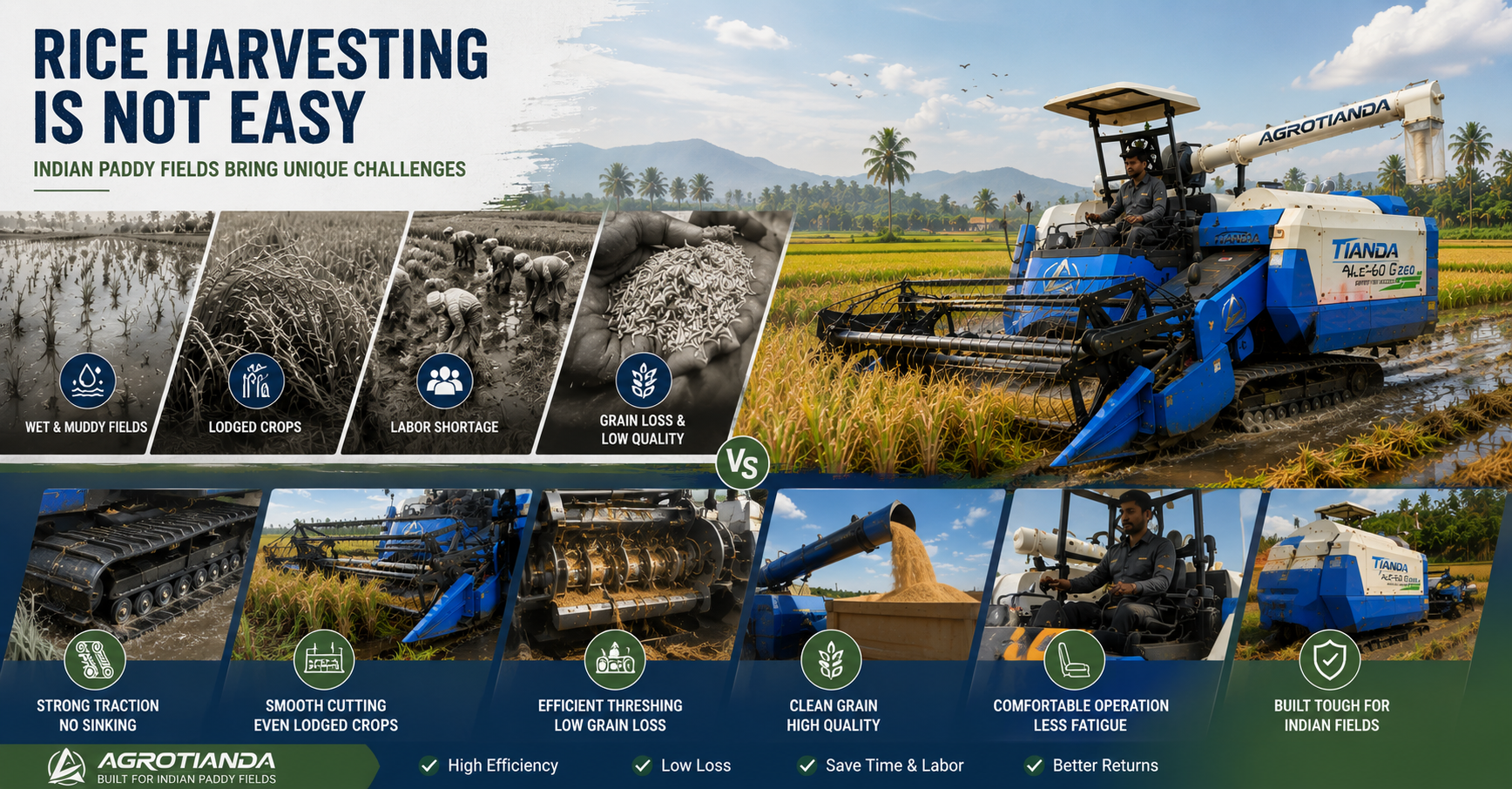
One of the biggest challenges you face when harvesting rice is the condition of the soil.
Depending on your irrigation system, rainfall, drainage, and harvesting season, your field may remain wet when the rice is ready.
A heavy machine operating on soft soil can experience:
Wheel or track sinking
Reduced traction
Slippage
Difficulty turning
Deep field ruts
Lower harvesting efficiency
If your fields are consistently wet, you should pay close attention to the machine's ground pressure and traction system.
This is one of the main reasons crawler-type combine harvesters are widely used for wet paddy conditions.
Rice plants do not always remain upright until harvest.
Heavy rain, strong winds, high grain weight, or other field conditions can cause the crop to lodge.
When rice plants are close to the ground, harvesting becomes more difficult.
You should therefore look at the header design, crop feeding system, cutting performance, and operator visibility when comparing machines.
Your rice crop does not wait for you.
Once the crop reaches the right maturity stage, harvesting needs to be completed efficiently.
A machine with a suitable working capacity allows you to cover more area within the available harvesting window.
For larger farms and harvesting contractors, this can have a direct impact on machine utilization and operating costs.
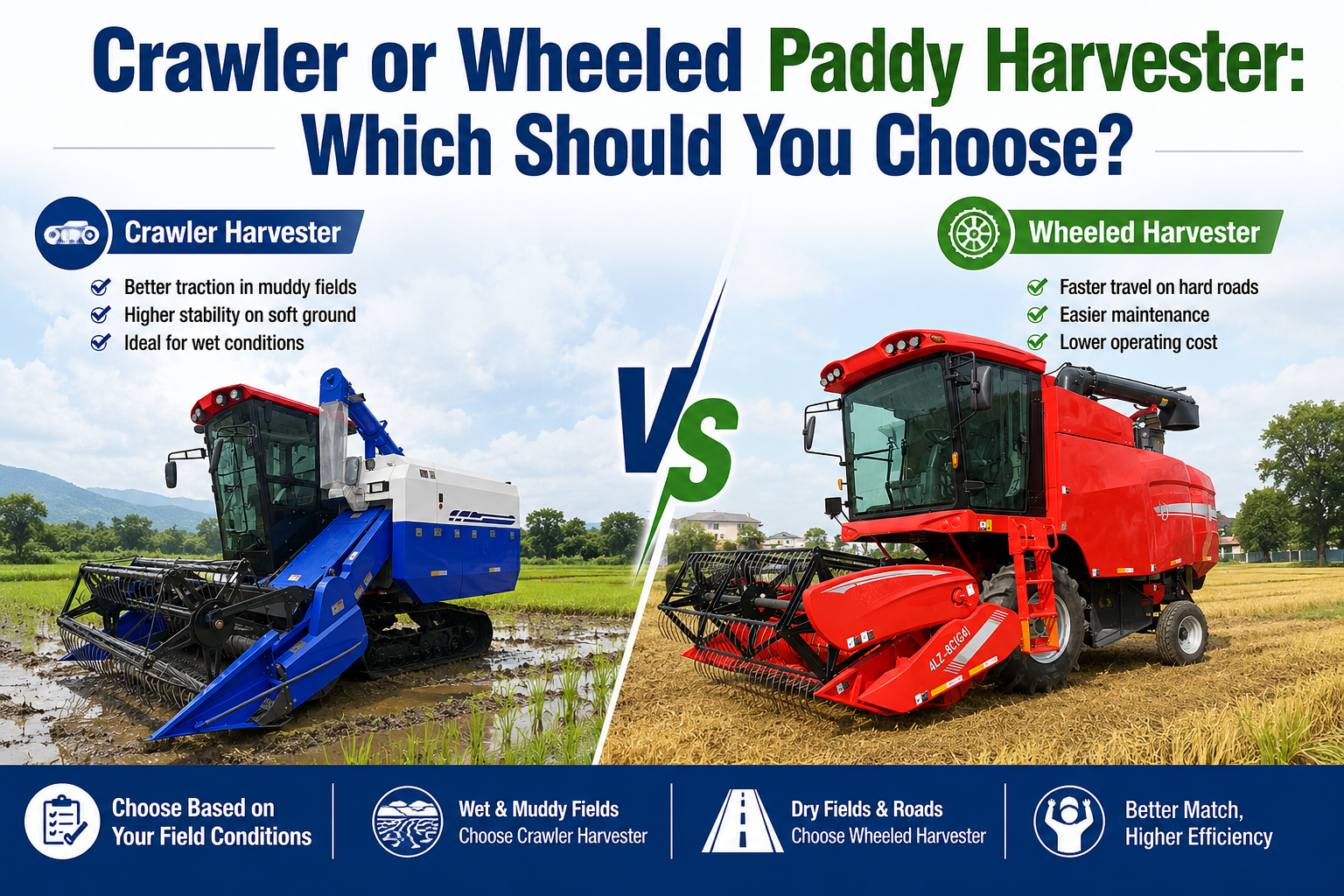
This is one of the most important questions you should ask before purchasing a rice combine harvester.
The answer depends mainly on your field conditions.
A crawler combine uses rubber tracks instead of conventional agricultural wheels.
Because the tracks have a larger contact area with the ground, the machine can distribute its weight over a wider area.
This can provide several advantages in wet and soft paddy fields:
Lower ground pressure
Better flotation
Stronger traction
Improved stability
Better performance in muddy soil
Reduced risk of sinking
If you regularly harvest rice in wet or soft fields, a crawler combine harvester in India may be a better choice for your operation.
You can also learn more about this topic in our guide:
Crawler Combine Harvester in India: Why It Is Ideal for Paddy Fields
Wheeled combines can be very effective when you work mainly in relatively firm and dry fields.
They can also offer advantages when you frequently need to move the machine between fields or travel on roads.
For you, the decision should therefore be based on the actual conditions you face during harvest rather than simply choosing one machine type because it has a higher horsepower rating.
| Factor | Crawler Combine | Wheeled Combine |
|---|---|---|
Wet paddy fields | Excellent | Moderate |
Soft or muddy soil | Excellent | Moderate |
Ground pressure | Lower | Higher |
Traction | Excellent | Good |
Field stability | Excellent | Good |
Dry fields | Very good | Excellent |
Road transportation | Moderate | Easier |
Paddy applications | Excellent | Good |
If your main harvesting environment is wet and muddy paddy fields, crawler configuration should be high on your list.
Before you compare different machines or request a quotation, take a close look at these seven factors.
Before looking at engine power, look at your field.
Ask yourself:
Is your soil usually wet during harvest?
Does the machine need to operate in standing water?
Is the soil soft or muddy?
Are your fields flat or uneven?
Are your field entrances narrow?
How difficult is it to turn at the end of each row?
If your field becomes very soft during the rice harvest, a crawler machine can give you an important advantage.
Your machine should be selected according to the conditions where you actually work, not just the conditions shown in a product brochure.
Engine power matters, but more horsepower does not automatically mean a better harvester for your farm.
You should consider engine power together with:
Cutting width
Threshing capacity
Crop density
Machine weight
Working speed
Field conditions
Fuel consumption
For example, if you operate in thick rice crops or difficult wet fields, sufficient engine power helps maintain performance under load.
At the same time, an oversized machine can increase purchase and operating costs without providing a meaningful benefit if your farm does not require its capacity.
The goal is to find the right balance between power, capacity, fuel efficiency, and field performance.
Cutting width directly affects how much crop you can cover during each pass.
A wider header can help increase field capacity, but you should not look at header width alone.
Consider:
Your average field size
Rice crop density
Field shape
Crop height
Engine power
Expected harvesting hours per day
If you are a harvesting contractor working across many farms, higher field capacity may be particularly important.
If you operate smaller fields, maneuverability may be more important than maximum header width.
A good rice harvester needs to do more than cut the crop.
After cutting, the machine needs to thresh the rice, separate the grain from straw and chaff, and clean the harvested grain.
This means you should pay attention to the entire harvesting system:
Feeding system
Threshing drum or rotor
Concave
Separation system
Cleaning fan
Sieves
Grain tank
Grain unloading system
Poor threshing or cleaning performance can increase grain loss and reduce grain quality.
The Indian Council of Agricultural Research provides technical information on rice production and emphasizes appropriate harvesting and post-harvest practices to minimize losses.
When comparing a rice combine harvester, do not judge it only by how quickly it can cut the crop.
Ask how well it performs throughout the complete harvesting process.
If you are buying a crawler paddy harvester, the crawler system deserves special attention.
You should check:
Track width
Ground contact area
Track material
Track durability
Traction
Turning performance
Ground clearance
Wider tracks can distribute the machine's weight over a larger area, which can help reduce ground pressure.
This is particularly useful when your rice fields are soft after irrigation or rainfall.
For example, modern rice combines designed for wet-field applications commonly use wide rubber crawlers to improve flotation and reduce ground pressure.
The important point is simple:
If you regularly work in mud, the crawler system is not just another specification. It is one of the most important parts of the machine.
A small percentage of grain loss can become a significant amount when you calculate it across several hectares.
Grain can be lost during:
Cutting
Feeding
Threshing
Separation
Cleaning
Unloading
When comparing different paddy harvesting machines, you should therefore ask suppliers about actual field performance.
Do not focus only on theoretical harvesting capacity.
A machine that harvests quickly but creates excessive grain loss may not be the most economical option for you.
Your relationship with a machinery supplier should not end when the machine arrives at your farm.
A combine harvester contains many mechanical, hydraulic, electrical, and transmission components.
Before buying, you should ask:
Are spare parts available?
How quickly can parts be shipped?
Is technical support available?
Is operator training provided?
What warranty is offered?
How can you get maintenance assistance?
Does the supplier support your local dealer?
For agricultural machinery, after-sales support can be just as important as the initial purchase price.
This is especially important if you are a dealer planning to introduce a paddy harvester in India to your local market.
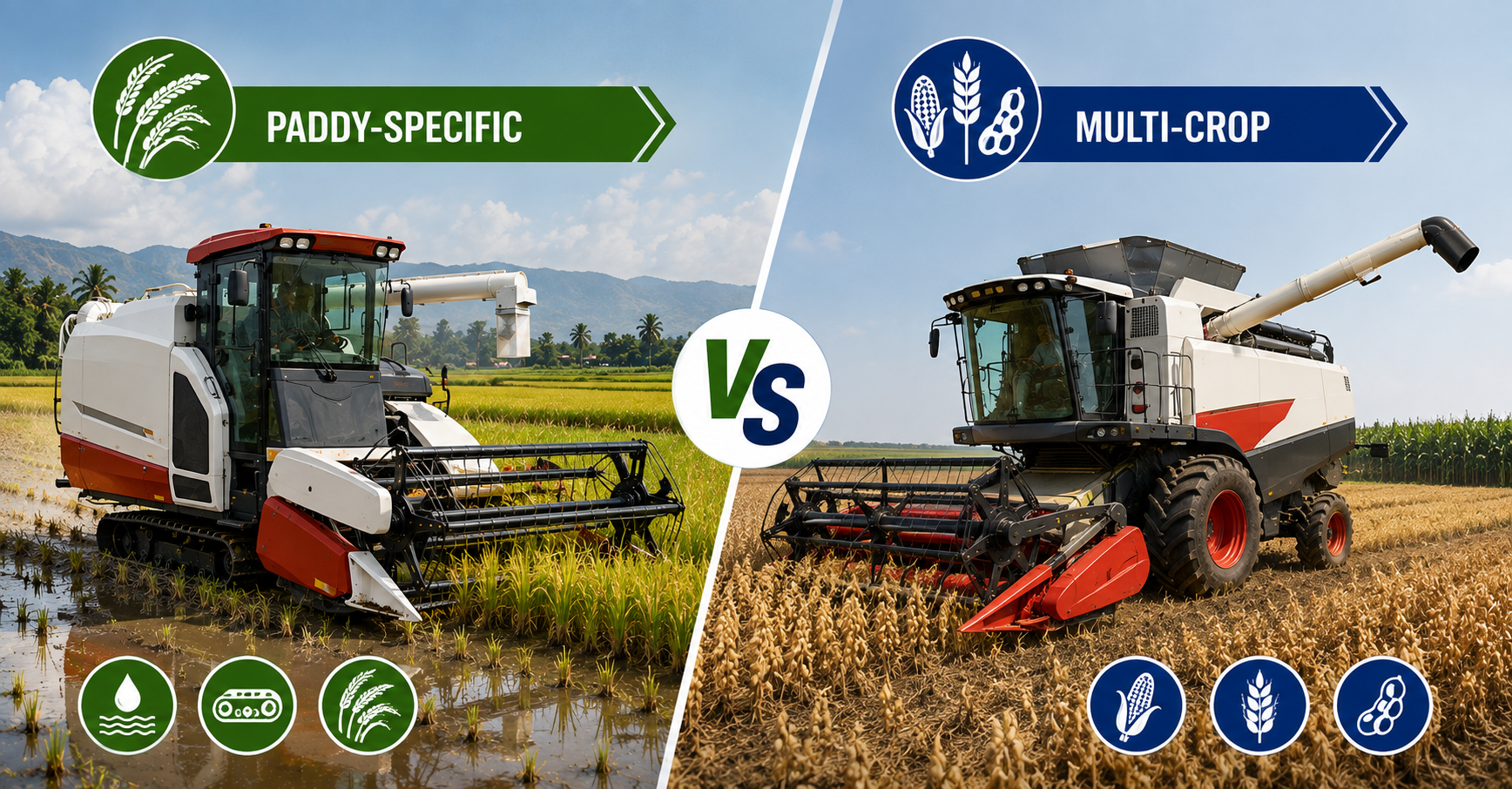
This depends on how you use the machine.
If almost all of your harvesting work involves rice, a machine optimized for paddy can be a logical choice.
But what if you also grow or harvest wheat, corn, or soybean?
In that case, a multi-crop combine harvester may provide better year-round utilization.
For example, you may use the same machine for:
Rice
Wheat
Corn
Soybean
Other compatible grain crops
This can be particularly attractive for harvesting contractors and agricultural machinery dealers.
Instead of having a machine that sits idle outside the rice harvesting season, you can potentially use a multi-crop combine across different crops and harvesting periods.
When calculating your investment, look beyond the purchase price.
Consider:
Annual harvesting area × number of crops × utilization period
The more useful your machine is throughout the year, the more opportunities you have to improve its return on investment.
There is no single machine that is the best choice for every Indian farm.
Your ideal machine depends on your soil, crop, field size, harvesting schedule, and budget.
However, if you frequently work in wet and soft paddy fields, a crawler paddy harvester is generally worth serious consideration.
The tracks can provide better flotation and traction, allowing you to work in conditions where a conventional wheeled machine may struggle.
If your fields are mainly dry and firm and you need to move the machine frequently between locations, a wheeled combine may provide greater transportation flexibility.
The key is to match the machine to your field.
Do not buy horsepower. Buy the performance you actually need.
If you are searching for a paddy harvester price in India, you will quickly find that there is no single price that applies to every machine.
The final cost depends on the machine configuration and specifications.
Some of the main factors include:
Engine horsepower
Crawler or wheeled chassis
Header width
Threshing system
Grain tank capacity
Cabin configuration
Harvesting capacity
Level of automation
Brand and supplier
Shipping and import costs
Optional equipment
For this reason, you should compare the complete machine specification rather than comparing price alone.
If you are purchasing for a farm, provide the supplier with your field conditions and expected annual harvesting area.
If you are a dealer, provide your target crops, customer requirements, expected quantity, and local market requirements.
This will allow the supplier to recommend a more suitable configuration.
Before you request a quotation, prepare these details:
Main crop: Rice / Paddy
Other crops: Wheat / Corn / Soybean
Total harvesting area: ___ hectares
Typical field condition: Wet / Soft / Dry
Soil type: ___
Average rice crop height: ___
Expected harvesting season: ___
Required working capacity: ___ ha/h
Preferred configuration: Crawler / Wheel
Engine power requirement: ___ HP
Grain tank requirement: ___
Cabin required: Yes / No
Dealer or farm use: ___
Spare parts requirements: ___
The more information you provide, the easier it is for a machinery supplier to recommend the right machine.
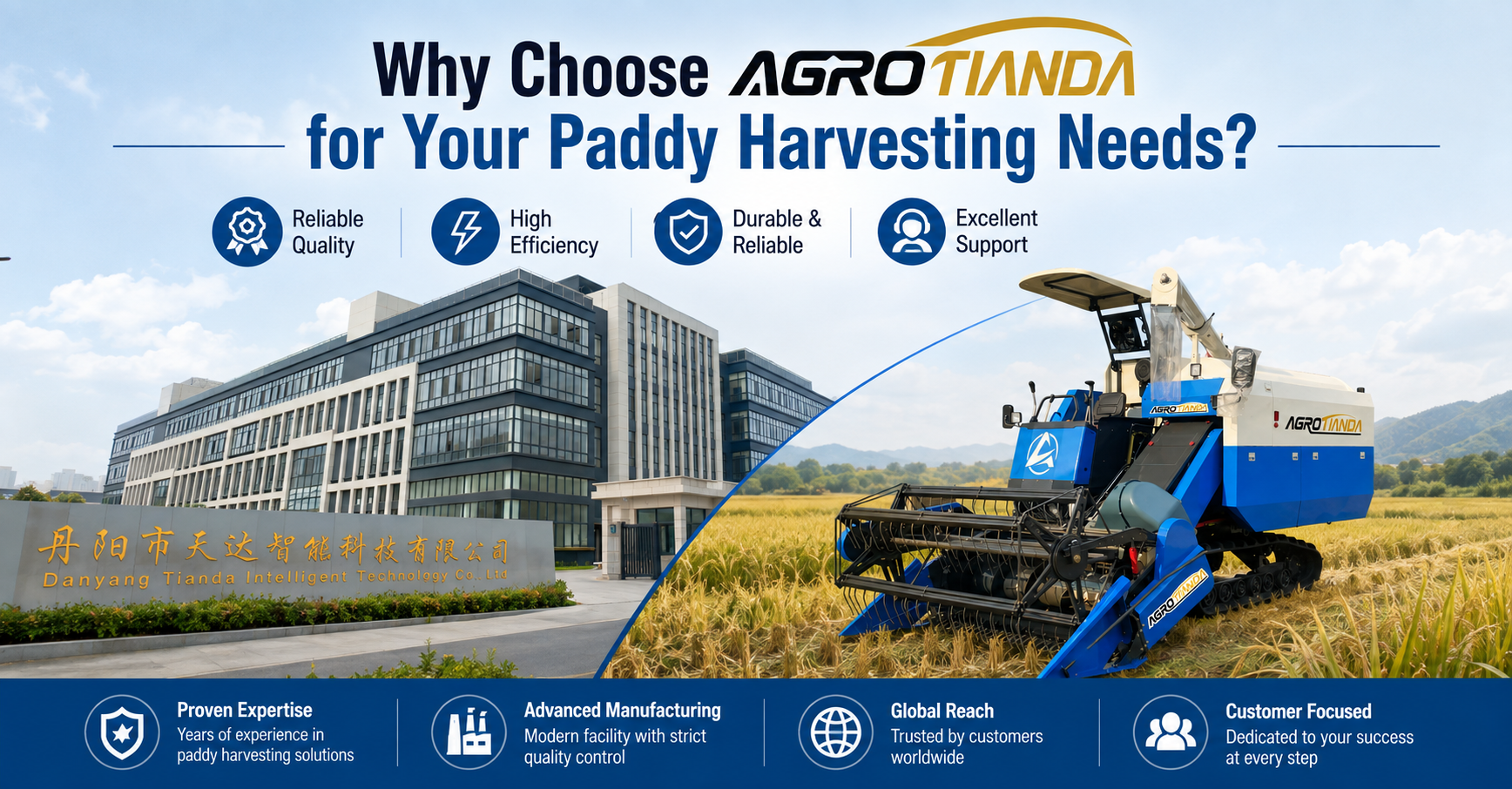
At Agrotianda, we understand that your harvesting conditions are not the same as those in every other market.
That is why we focus on matching the machine configuration with the actual application.
For Indian rice fields, we can provide combine harvesting solutions designed for different field conditions and crop requirements, including crawler-type machines for wet paddy applications and multi-crop configurations for customers who harvest more than one grain crop.
Our combine harvester range covers different horsepower and configuration options, allowing you to select a machine based on your required capacity rather than forcing every customer into the same specification.
If you are a farmer, harvesting contractor, or agricultural machinery dealer in India, you can share your crop type, field conditions, harvesting area, and required capacity with our team.
We can then help you identify a suitable configuration for your application.
Choosing the right paddy harvester in India starts with understanding your own fields.
If you regularly harvest rice in wet and muddy conditions, pay close attention to crawler design, ground pressure, traction, and stability.
If you work across different crops, consider whether a multi-crop combine can give you better machine utilization.
And when comparing machines, look beyond horsepower and purchase price. Cutting performance, threshing efficiency, grain loss, fuel consumption, maintenance, spare parts, and after-sales support all affect the real cost of ownership.
The right rice harvesting machine should help you harvest at the right time, reduce unnecessary labor, protect your grain yield, and keep your operation productive throughout the harvesting season.
Looking for a paddy harvester for the Indian market? Contact Agrotianda and tell us about your crop, field conditions, harvesting area, and required capacity. We can help you find the right combine harvester configuration for your needs.
The best machine depends on your field conditions. If you regularly harvest rice in wet, soft, or muddy fields, a crawler combine harvester can be a strong choice because it provides better ground contact, traction, and flotation.
For wet and soft paddy fields, a crawler combine is generally more suitable. Wheeled combines can be a better option when the fields are relatively firm and road transportation is a major consideration.
You should consider field conditions, engine power, cutting width, harvesting capacity, threshing and cleaning performance, ground pressure, grain loss, fuel consumption, spare parts, warranty, and after-sales support.
Yes. Many multi-crop combine harvesters can be configured to harvest both rice and wheat. If you harvest several crops each year, a multi-crop machine can potentially provide better annual utilization.
It depends on your total harvesting area and machine capacity. For smaller farms, a compact or mini combine may be more practical. You should also consider whether you can share the machine with nearby farmers or use it as a custom harvesting service.


