

Views: 0 Author: Site Editor Publish Time: 2026-09-14 Origin: Site
Loading a farm tractor onto a trailer is a routine job for many farms, dealers, and equipment operators—but it is never a task to rush. A tractor’s weight, high center of gravity, attachments, and uneven tire loading can turn a simple transport job into a serious safety risk if the trailer, ramps, or tie-downs are not properly matched.
The key is to prepare the equipment, load slowly on level ground, distribute weight correctly, and secure the tractor at multiple approved points. Whether you are moving a compact machine or a high-horsepower 4WD model, the same disciplined process helps protect the operator, tractor, trailer, and other road users.
Before loading, verify the trailer’s payload capacity—not only its overall rating. The trailer must safely carry:
The tractor’s operating weight
Front loaders, counterweights, cabs, wheel weights, or ballast
Attached implements such as mowers, tillers, plows, or loaders
Fuel, tools, chains, and accessories
Do not estimate by horsepower alone. Two tractors with similar horsepower can have very different operating weights. Check the tractor specification plate or manual, then compare the total loaded weight with the trailer’s rated capacity, axle ratings, tire ratings, ramp capacity, and towing vehicle capacity.
A suitable trailer should also be wide enough for the tractor’s tire track and long enough to position the machine for proper tongue weight. For larger equipment, choose a heavy-duty equipment trailer with reinforced ramps, brakes, appropriate deck space, and multiple tie-down points.
If you are selecting machinery for different transport conditions, explore the Agrotianda tractor range to compare configurations and operating requirements before arranging delivery.
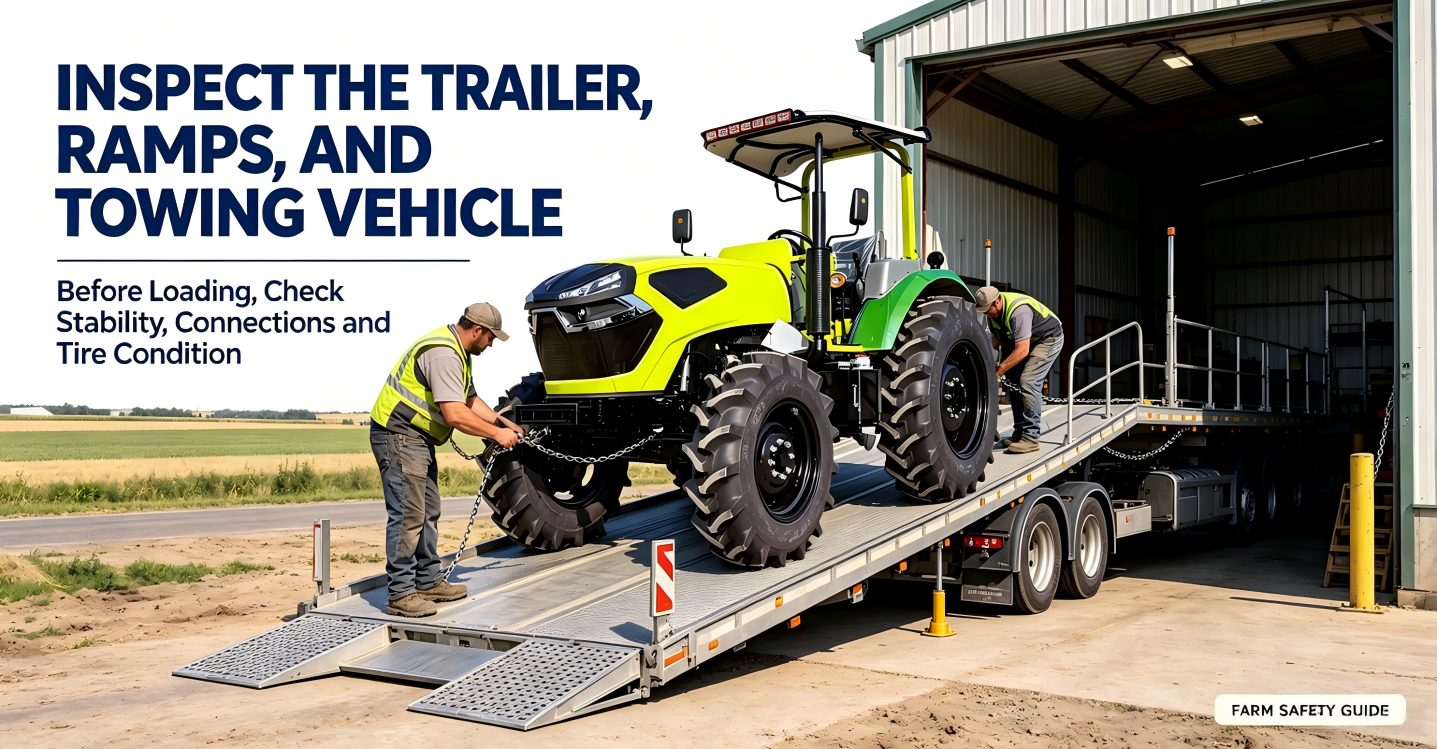
Park the towing vehicle and trailer on firm, level ground. Avoid soft soil, slopes, loose gravel, or wet grass, where ramps can shift or the trailer can move unexpectedly.
Before loading, inspect:
Trailer hitch, safety chains, breakaway cable, and electrical connection
Trailer brakes and lights
Tires for pressure, wear, and visible damage
Wheel chocks and parking brake
Trailer deck for oil, mud, ice, or loose debris
Loading ramps for damage, secure locking, and adequate weight rating
Tie-down chains, straps, binders, hooks, and anchor points
The trailer must be correctly coupled to the tow vehicle before the tractor approaches the ramps. Chock the trailer wheels if necessary. Never rely only on the towing vehicle’s parking brake when loading heavy machinery.
Remove loose items from the cab, fenders, loader bucket, and operator platform. Fold or secure any parts that could extend beyond the trailer width. If an implement is attached, make sure it is compatible with the trailer length and weight limit.
Lower any raised attachment as much as practical before approaching the ramps. For tractors with a front-end loader, keep the bucket low and close to the tractor to reduce the center of gravity. Avoid carrying a raised loader, boom, or implement while climbing the ramps.
Check that the tractor is in the correct drive range. Use low gear, low engine speed, and four-wheel drive when the tractor manufacturer recommends it for loading traction. Do not change gears halfway up the ramps.
Position the tractor directly in line with the ramps. The front tires should meet both ramps evenly. If the tractor approaches at an angle, one wheel may climb before the other, causing the machine to tilt or slide.
Use a spotter when visibility is limited, especially with enclosed cabs, wide implements, tall rear tires, or narrow ramps. The spotter should stand to the side in a clearly visible position—not between the trailer and tractor and never behind the tractor.
Drive slowly and steadily. Avoid sudden acceleration, braking, steering changes, or clutch release. Keep the tractor centered as it moves onto the deck. If the tractor begins to drift, stop safely, back down if conditions allow, realign, and start again. Do not attempt to correct a serious misalignment while halfway up the ramps.
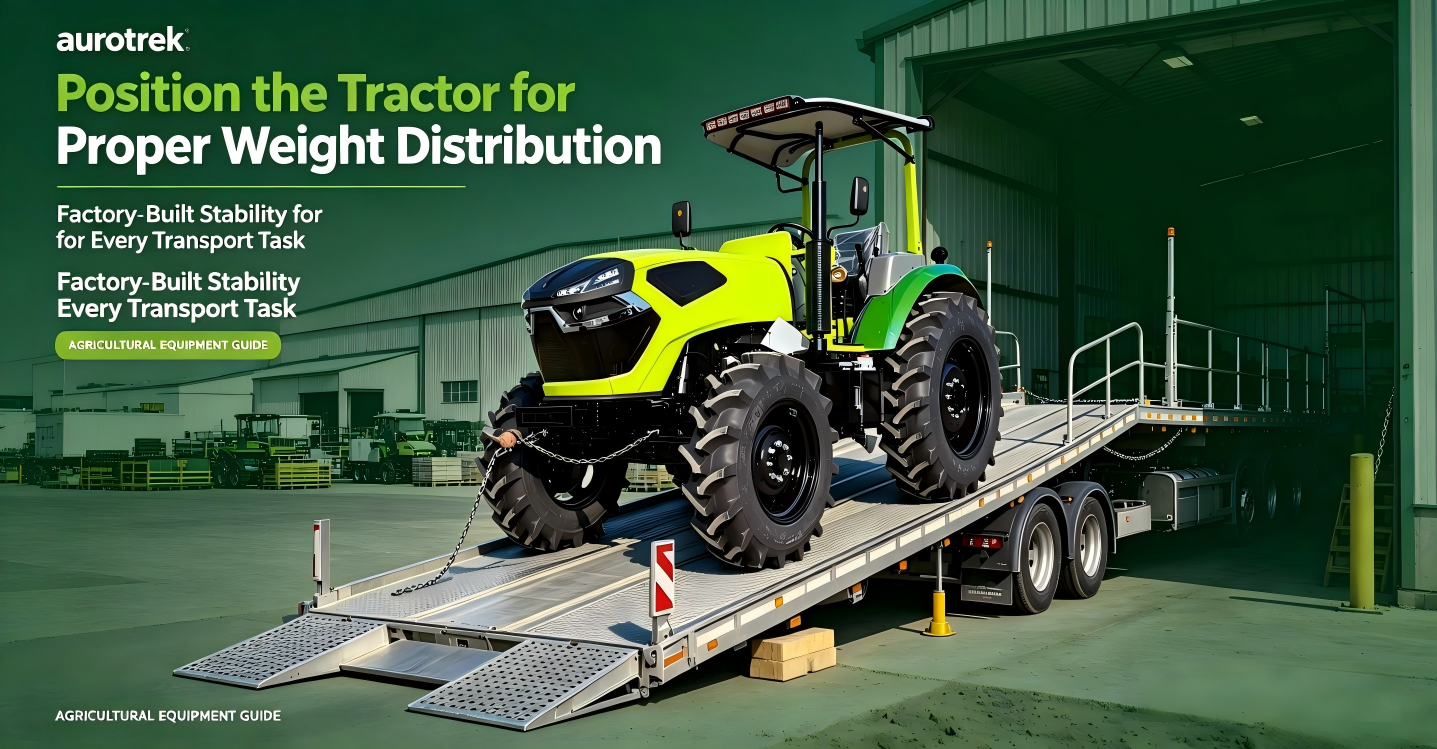
Once on the trailer, position the tractor so the load is balanced from side to side and the trailer has sufficient, stable tongue weight. Too much weight at the rear can cause trailer sway; too much weight at the front can overload the hitch or rear axle of the towing vehicle.
As a practical loading principle:
Load position | Potential problem |
Too far forward | Excessive tongue weight, poor steering response, overloaded tow vehicle |
Too far rearward | Trailer sway, reduced towing stability, light steering axle |
Offset to one side | Uneven tire loading and unstable handling |
Centered over the deck | Better balance and more predictable towing |
The ideal position depends on the trailer design, axle location, tractor weight, and attached equipment. Make small adjustments before securing the machine. Once the tractor is correctly positioned, place it in park or the lowest gear, set the parking brake, shut off the engine, and remove the key.
A tractor should be restrained with properly rated chains or heavy-duty tie-downs attached to strong, designated points on both the tractor and trailer. Four-point securement is a dependable approach because it limits forward, rearward, and side-to-side movement.
Use suitable attachment points such as approved frame locations, drawbar areas, axle housings, or manufacturer-recommended tie-down points. Avoid attaching chains to steering linkages, hydraulic lines, light brackets, sheet metal, or removable implements unless they are specifically designed for securement.
A reliable setup normally includes:
Two restraints pulling forward from the rear of the tractor
Two restraints pulling rearward from the front of the tractor
Tensioned chains or straps that prevent the tractor from shifting
Separate securement for detached implements or loader attachments
Secured ramps, tools, and loose accessories
Crossing chains may improve lateral restraint when appropriate, but ensure chains do not rub against sharp edges, hoses, tires, or painted surfaces. After tightening binders, lock or secure the handles so vibration cannot release them during transport.
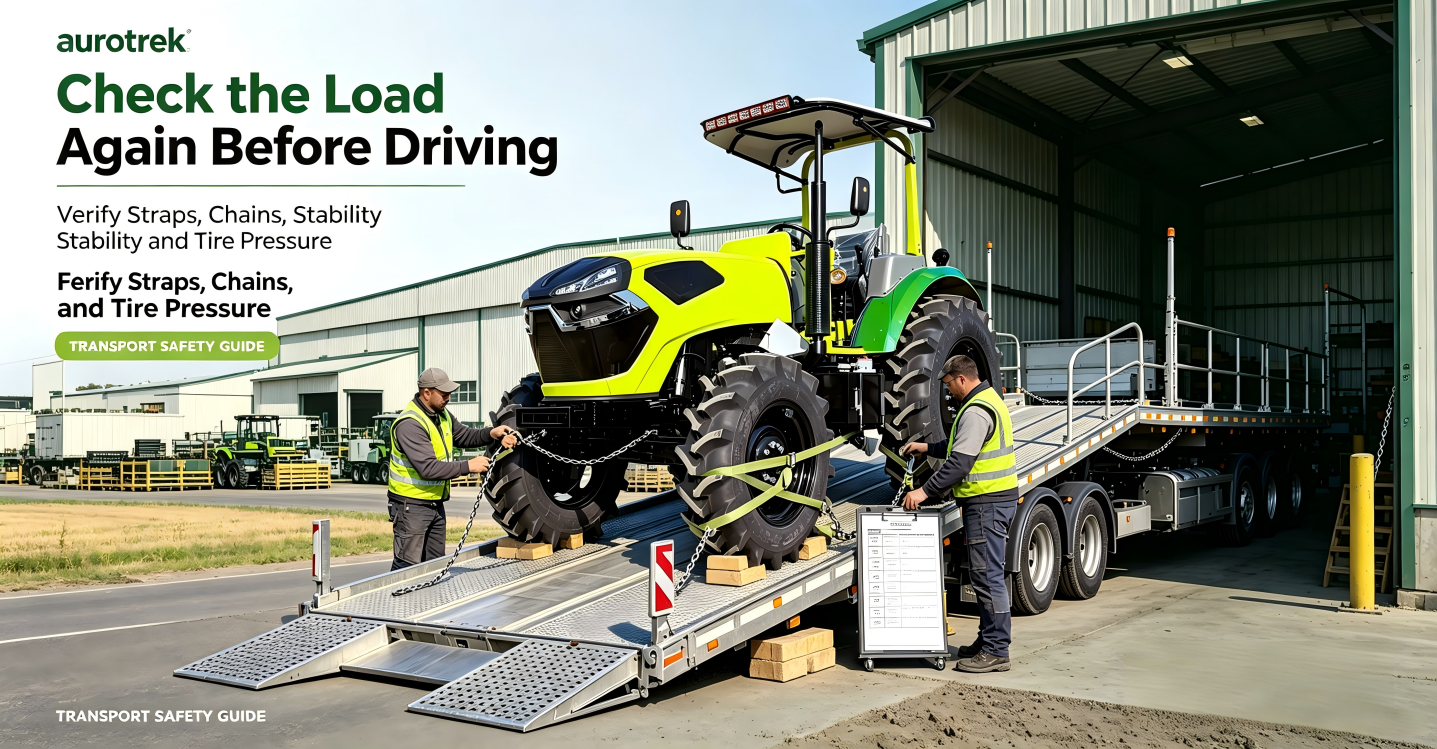
Walk around the trailer before leaving. Confirm that ramps are fully stowed and locked, chains are tight, lights are working, and no attachment can swing or drop. Check the tractor’s width, height, and rear overhang, particularly when transporting a cab tractor, loader, or rear-mounted implement.
After driving a short distance, stop in a safe location and inspect the load again. Chains and straps can settle as the tractor tires compress or the trailer flexes. Re-tighten any restraint that has loosened. Repeat inspections during long trips, after rough road sections, and whenever you stop for fuel.
The most frequent loading mistakes are preventable:
Loading on a slope or soft ground
Using ramps that are too narrow, too steep, or not rated for the tractor
Guessing the tractor weight instead of checking it
Driving up ramps too quickly
Loading with a raised loader or attachment
Positioning too much weight behind the trailer axles
Using worn, undersized, or damaged tie-down equipment
Securing only the tractor while leaving implements loose
Failing to recheck chain tension after departure
Safe tractor transport begins before the tractor touches the ramps. Match the trailer to the actual loaded weight, prepare a level loading area, drive straight and slowly, balance the load, and use secure four-point restraint. These steps reduce the risk of equipment damage, trailer sway, shifting loads, and roadside incidents.
For a tractor configuration suited to your farm operation, terrain, and transport needs, contact Agrotianda for product and configuration support.
In most cases, loading the tractor forward places the heavier engine toward the front of the trailer and supports stable tongue weight. However, trailer layout, attached implements, and axle position can affect the best orientation. Confirm balance before securing the load.
Heavy-duty rated straps can be suitable when they are correctly sized, undamaged, and attached to approved securement points. Chains and binders are often preferred for heavy tractors because they are highly resistant to abrasion and provide strong restraint.
Yes. After positioning the tractor, place it in park or the lowest gear, apply the parking brake, turn off the engine, and remove the key. Tie-downs remain the primary restraint; the drivetrain and brake are additional safeguards.
If the loader or bucket is attached and can move independently, lower it onto the trailer deck when possible and secure it as needed. Any removable attachment, implement, or accessory must be restrained so it cannot shift in transit.
Inspect them before departure, after the first short section of travel, and regularly throughout the trip. Recheck immediately after rough roads, sharp braking, or any event that may have shifted the load.
Disclaimer: This guide provides general safety recommendations. Always follow your tractor and trailer manufacturer’s official operation manual and comply with local road‑transport regulations. Agrotianda accepts no liability arising from field operations based on this article.


