

Views: 0 Author: Site Editor Publish Time: 2026-08-25 Origin: Site
A new farm tractor in 2026 can cost anywhere from about USD 15,000 for a basic compact model to more than USD 350,000 for a high-horsepower agricultural machine. The right budget depends less on the sticker price than on what the tractor must do: implement size, terrain, working hours, lifting requirements, operator comfort, and the level of technology required.
For many farms, the most practical buying range is USD 30,000–90,000 for a 50–100HP utility tractor. Larger operations that need 4WD, a cab, stronger hydraulics, and wide implements should expect a substantially higher investment.
Tractor category | Typical horsepower | Estimated new price range | Typical applications |
Compact / small utility tractor | 25–50HP | USD 15,000–40,000 | Mowing, orchards, livestock chores, light transport |
Utility tractor | 50–100HP | USD 30,000–90,000 | Tillage, spraying, loader work, hay and mixed farming |
Mid-power farm tractor | 100–180HP | USD 60,000–180,000 | Seeding, cultivation, heavy transport, medium-to-large farms |
Heavy-duty tractor | 180–300HP | USD 120,000–350,000 | Deep tillage, large implements, commercial field operations |
High-horsepower / precision tractor | 300HP+ | USD 250,000–700,000+ | Wide-scale row-crop farming and intensive production |
These are planning ranges, not fixed quotations. Final pricing varies by country, engine-emissions requirements, configuration, shipping terms, attachments, and local taxes or import duties.
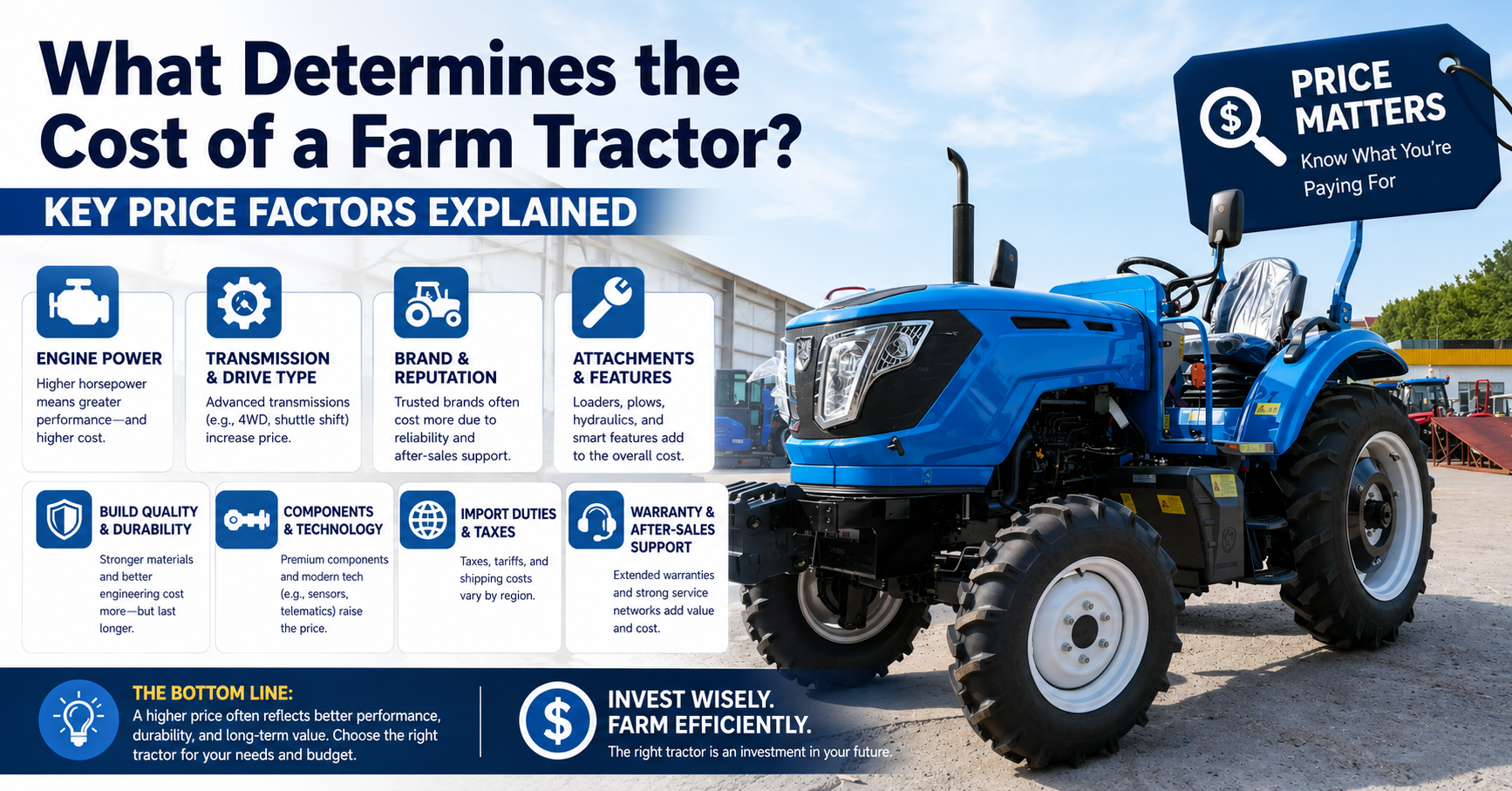
Horsepower is one of the clearest price drivers. More engine power usually means a larger chassis, stronger drivetrain, higher hydraulic flow, heavier axles, and greater lifting capacity.
A 50HP tractor may be sufficient for mowing, light cultivation, loader work, and small-to-medium farm tasks. A 100–150HP machine is more suitable when the farm relies on larger plows, planters, trailers, or repeated field work. For wide implements and demanding soil conditions, buying too little power can be more expensive over time because it slows operations and limits implement choices.
However, engine horsepower alone should not determine the purchase. Buyers should also compare PTO power, hydraulic output, three-point-hitch lift capacity, tractor weight, and traction.
4WD tractors cost more than comparable 2WD machines, but the additional traction can be worthwhile in loose soil, slopes, wet fields, orchards, or paddy conditions. Better traction can reduce wheel slip, improve implement performance, and help the operator work in conditions where a 2WD tractor may struggle.
For farms with uneven ground or frequent heavy pulling, 4WD is often a value-focused choice rather than simply an upgrade.
Transmission design has a major effect on both purchase price and ease of operation.
Manual or gear transmissions are typically the most economical.
Shuttle-shift systems make repeated forward-and-reverse work more convenient, especially with a front loader.
Powershift and continuously variable transmissions provide smoother operation and more productivity, but increase the upfront price.
Hydrostatic transmissions are popular for compact tractors and loader work, although they may not be the best fit for every heavy-draft application.
The best transmission is the one that matches the tractor’s main task. A machine used mostly for field pulling may need a different setup from a tractor used all day for loading, feeding, and transport.
An open-station tractor is usually more affordable. Adding an enclosed cab can significantly raise the price, but it offers valuable benefits for farms with long working days or difficult weather.
A cab may include air conditioning, heating, dust protection, better visibility, suspension seating, work lights, and lower operator fatigue. For a tractor that operates intensively during planting, spraying, harvesting, or transport seasons, those features can support productivity and safety.
The tractor must have enough hydraulic capacity and hitch strength for the implements it will use. A low initial price is not a good deal if the machine cannot lift a loaded implement, operate a hydraulic attachment efficiently, or provide the correct PTO speed.
Before requesting a quotation, list every implement you expect to use, including:
Front-end loader
Rotary tiller or cultivator
Plow
Seeder or planter
Sprayer
Mower or baler
Trailer
Post-hole digger
Forklift attachment
This list helps ensure the tractor configuration is compatible from the beginning.
Tire choices affect both price and real-world performance. Dryland, paddy-field, radial, and industrial tires have different strengths. A farm that works in mud or wet soil may need a tire setup with better flotation and grip, while orchard or road-transport work may prioritize maneuverability and reduced soil disturbance.
Choosing the correct tire type at the time of purchase is usually easier and more economical than changing the setup later.
The tractor itself is only part of the investment. Attachments and implements may add thousands—or much more—to the completed working package.
Common item | Typical budget impact |
Front-end loader | USD 3,000–10,000+ |
Rotary mower or cutter | USD 1,500–8,000+ |
Tiller or cultivator | USD 1,500–10,000+ |
Plow | USD 1,000–15,000+ |
Seeder or planter | USD 2,000–30,000+ |
Front or rear weights | USD 500–3,000+ |
Trailer | USD 2,000–15,000+ |
Guidance or precision-farming system | USD 5,000–30,000+ |
Actual costs depend on working width, build quality, compatibility, and whether the equipment is purchased as a package.
A useful buying rule is to budget for the full operating system—not just the tractor. A tractor with the correct loader, tire setup, ballast, hitch category, and implements will produce more value than a more powerful tractor that is poorly matched to the job.
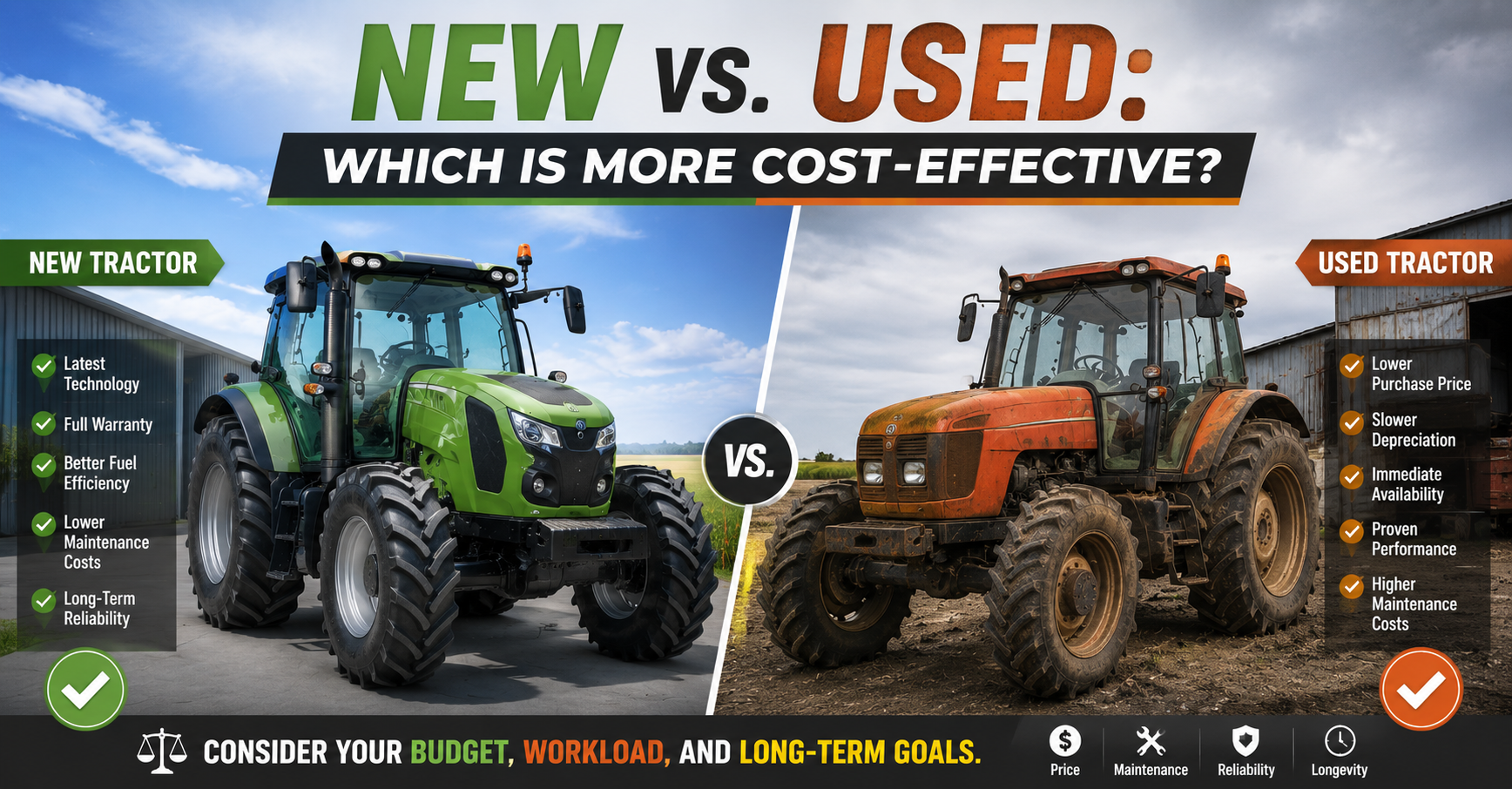
A used tractor can reduce the initial investment, but buyers should evaluate condition carefully. Lower purchase cost can be offset by repairs, downtime, unavailable parts, or mismatched attachments.
A used tractor may be a good choice when:
The machine has documented maintenance history.
Hours are reasonable for its age and working type.
Hydraulics, PTO, transmission, and 4WD have been inspected.
Local parts and technical support are available.
The tractor already includes useful implements.
A new tractor is often preferable when a farm needs predictable uptime, warranty coverage, modern emissions compliance, customized specifications, or a machine configured precisely for its operation.
Purchase price is important, but it is not the complete cost. A realistic budget should include:
Fuel or energy use
Routine servicing and fluids
Filters, belts, tires, and wear parts
Insurance and registration where applicable
Operator training
Storage and security
Transport and delivery
Financing interest
Downtime during peak farming periods
For commercial farms, downtime can be especially costly. A tractor that is slightly more expensive but offers dependable parts support and service access may be the stronger long-term investment.
Start with the farm’s hardest recurring task, not its easiest one. Ask these questions:
1. What implement requires the most power?
2. How heavy are the loads the tractor must lift or pull?
3. Is the terrain flat, hilly, muddy, rocky, or narrow?
4. How many hours per week will the tractor operate?
5. Does the operator need an enclosed cab?
6. Will the tractor be used mainly for fieldwork, loading, transport, or a mix of jobs?
7. Are spare parts and service available in your region?
8. Is future expansion likely within the next three to five years?
Avoid paying for features that will not be used, but do not under-specify essentials such as traction, hydraulic capacity, safety equipment, and implement compatibility.
A small mixed farm may choose a 50–75HP 4WD tractor with a loader, three-point hitch, suitable tires, and a basic cab or canopy. Depending on configuration and delivery requirements, the total working package may fall around USD 35,000–75,000.
A larger crop farm that needs 120–150HP, an enclosed cab, stronger hydraulics, and heavy-duty implements may budget USD 90,000–200,000 or more. The final amount depends heavily on the transmission, axle capacity, precision features, attachment package, and shipping destination.
For buyers comparing configurations from 50HP through 240HP, explore Agrotianda’s agricultural tractor range. The range includes options for general farm work, orchard operations, heavy-duty traction, and customized requirements.
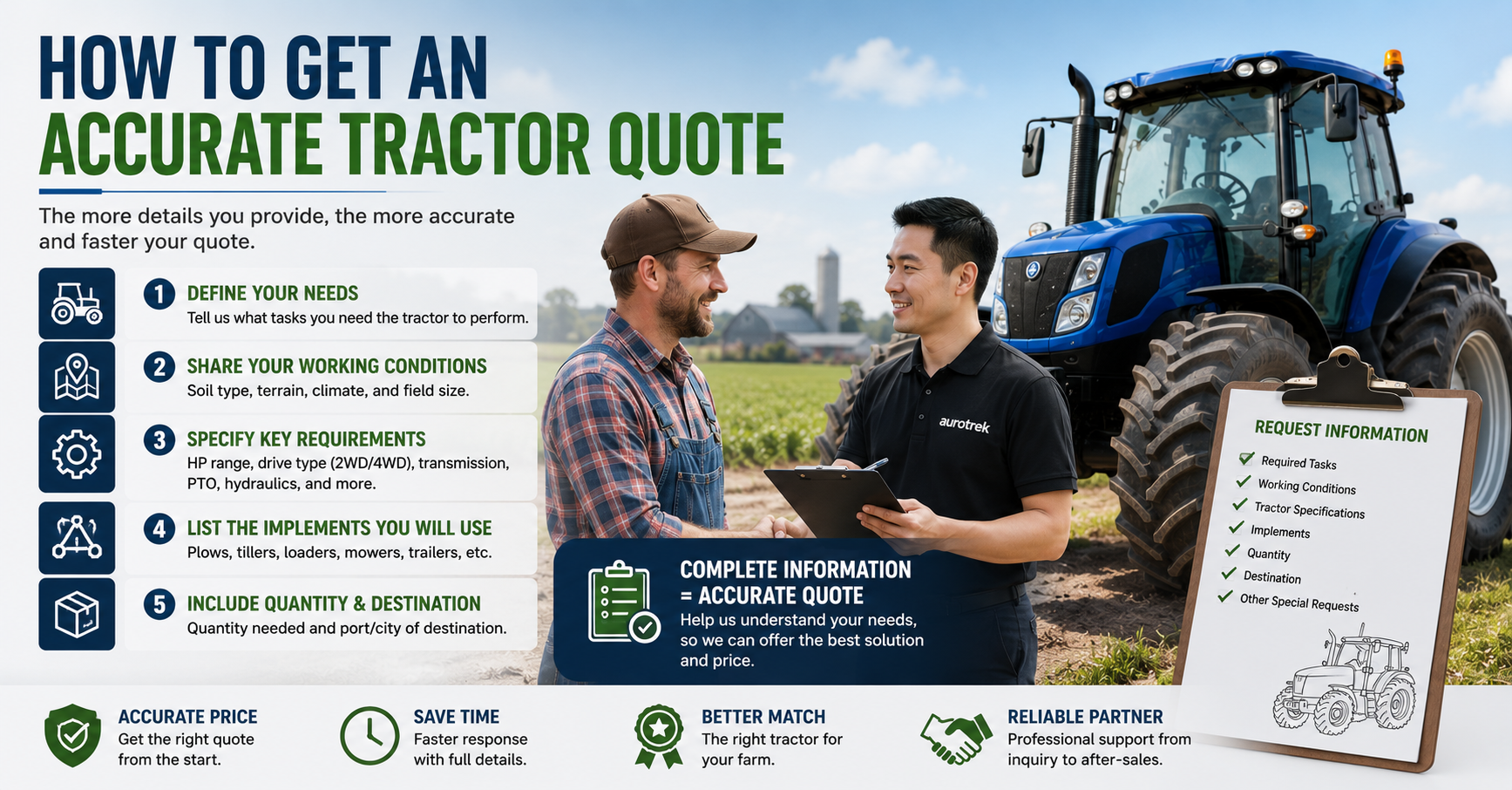
To receive a meaningful quotation, provide the supplier with:
Required horsepower range
Main crops and working conditions
Farm size and terrain
Required implements
Preferred transmission
2WD or 4WD requirement
Cab or open-station preference
Tire type
Destination port or delivery country
Quantity and customization requirements
This information helps the supplier recommend a configuration that fits the farm instead of quoting a base model that may not meet operational needs.
In 2026, a farm tractor can cost from approximately USD 15,000 to more than USD 350,000, while specialized high-horsepower machines can exceed that range. Most buyers should focus on the total operating package: horsepower, traction, hydraulics, implements, support, and lifetime operating cost.
The best tractor is not necessarily the cheapest or the most powerful. It is the machine that can complete your regular work efficiently, safely, and reliably for years to come. For configuration advice or a tailored quote based on your farm conditions, contact Agrotianda.
A capable new tractor for a small farm commonly costs around USD 20,000–50,000, depending on horsepower, 4WD, loader inclusion, and attachments. Many small farms find that 25–50HP is adequate, but the correct size depends on the implements and terrain.
A 50HP tractor can handle many jobs, including mowing, loader work, light tillage, spraying, transport, and general livestock tasks. It may be insufficient for large implements, deep tillage, or high-output commercial field operations.
Tractors combine high-output diesel engines, transmissions, hydraulics, reinforced frames, axles, safety systems, electronics, and specialized manufacturing. Features such as 4WD, cabs, loaders, precision guidance, and stronger hydraulic systems further increase the price.
A cab tractor is usually worthwhile when the machine will operate for long hours, in dust, heat, cold, rain, or pesticide-application environments. For occasional light work in mild conditions, an open-station tractor may offer better value.
Both matter. Horsepower determines the tractor’s ability to pull and power implements, while hydraulic capacity affects lifting and hydraulic attachment performance. The correct choice depends on the work you do most often.


