

Views: 0 Author: Site Editor Publish Time: 2026-08-31 Origin: Site
When purchasing a tractor, many buyers focus on horsepower, attachments, and price. However, one question is often overlooked: does a farm tractor need a title?
The answer depends on where the tractor is used and how it is classified. Unlike passenger vehicles, agricultural tractors are often considered farm equipment, which means ownership documentation may be different from a car or truck.
A vehicle title is an official ownership document issued by a government authority. It normally identifies the legal owner and records key machine details, such as the make, model, year, and vehicle identification number (VIN) or serial number.
For passenger vehicles, a title is common. For agricultural tractors, the rules are less uniform. Many jurisdictions treat a farm tractor as agricultural equipment or an implement of husbandry rather than a road vehicle. In those places, the authority may not issue a title for a standard farm tractor at all.
That does not mean ownership is unimportant. It means the ownership record may take a different form, such as:
Manufacturer’s certificate of origin
Sales invoice
Bill of sale
Finance agreement or release of lien
Import and customs documents
Registration certificate, where applicable
Serial-number record and equipment insurance policy
Whether a tractor needs a title depends mainly on three factors:
1. Your location: Titling laws differ widely between jurisdictions.
2. How the tractor is used: Private-farm use is often treated differently from commercial road use.
3. How the tractor is classified: A farm tractor, road tractor, truck tractor, and construction machine may fall under different rules.
In many areas, a conventional agricultural tractor used primarily for fieldwork does not need a title or standard vehicle registration. However, exceptions may apply when the machine is used regularly on public roads, converted for another purpose, operated for hire, or brought in from another jurisdiction.
Before completing a purchase, check the requirements of the authority responsible for vehicle or agricultural-equipment records where the tractor will be kept and operated.
This article provides general information, not legal advice. Local rules can change, so buyers should confirm the current requirements before purchase, registration, transport, or road operation.
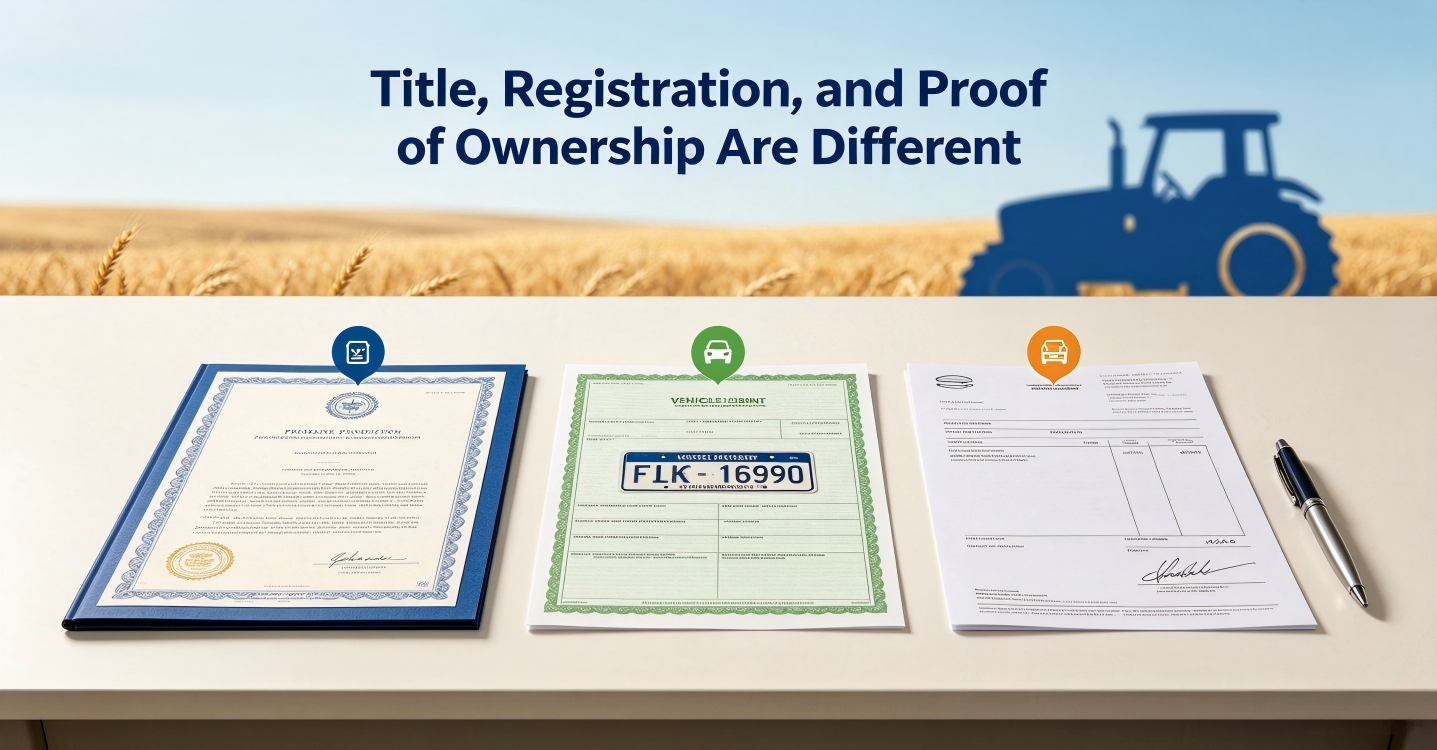
These terms are often confused, but they serve different purposes.
Document or record | What it shows | Why it matters |
Title | Legal ownership where titles are issued | May be required for transfer, financing, or registration |
Registration | Permission to operate on public roads in certain situations | May be required for road travel, plates, or permits |
Bill of sale | The details of the private transaction | Helps prove when, from whom, and for how much the tractor was purchased |
Manufacturer’s certificate of origin | The machine’s first ownership record when sold new | Important for new tractors and future ownership transfer |
Serial-number record | The unique identity of the tractor | Helps with theft checks, insurance, service, and resale |
Lien release | Confirms a lender no longer has a claim on the machine | Essential when buying a financed tractor |
A tractor can be legally owned without being road-registered. Likewise, a bill of sale can be essential even where no title exists.
A title or registration requirement becomes more likely in the following situations.
Many places allow farm equipment to travel on public roads only for limited agricultural purposes, such as moving between fields, going for repair, or transporting equipment related to farm work. Even where title is not required, road use may involve rules for:
Slow-moving vehicle markings
Lighting and reflectors
Width limits
Escorts or permits for oversized machinery
Insurance
Hours or routes of operation
Operator age or licensing
A tractor that only crosses a road occasionally may be treated differently from one used frequently for transport.
Using a tractor to perform paid work for other farms, move commercial goods, or provide transport services can change its legal classification. The tractor may no longer qualify for an agricultural exemption that applies to equipment used only in the owner’s farming operation.
A tractor fitted with special road equipment, converted for construction work, or configured for a non-agricultural commercial purpose may be subject to different rules. Modifications can also affect insurance coverage and resale documentation.
Imported tractors require a reliable paper trail. Depending on the destination, you may need customs records, an invoice, a certificate of origin, serial-number documentation, safety or emissions information, and proof of tax payment before the tractor can be registered or insured.
For buyers sourcing new equipment internationally, request the full documentation package before shipment. A properly documented machine is easier to insure, finance, resell, and register if local rules require it later.
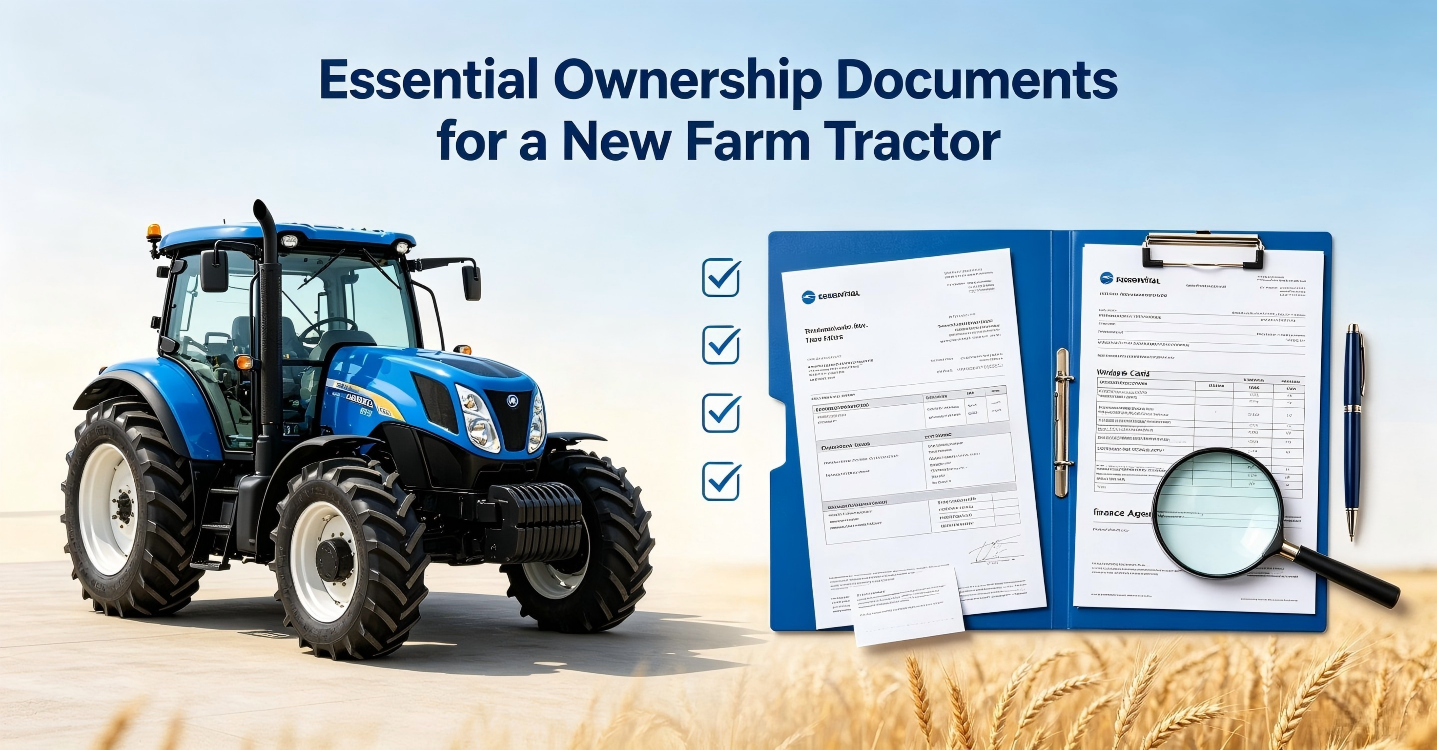
A new tractor should come with a clear document package. Keep the originals in a secure place and store digital copies separately.
Your purchase file should include:
Signed sales invoice with seller and buyer details
Manufacturer’s certificate of origin, if issued
Tractor make, model, engine number, and chassis/VIN or serial number
Delivery or acceptance record
Warranty terms and service information
Finance agreement, if applicable
Proof of payment
Import, shipping, and customs documents for imported equipment
Any local registration, tax, or insurance documents
When comparing new equipment, documentation should be part of the buying decision—not an afterthought. A manufacturer that provides clear machine identification, product information, and ongoing support helps protect your long-term ownership value.
For international tractor buyers, documentation becomes even more important. When purchasing tractors from overseas manufacturers, buyers should confirm the machine serial number, commercial invoice, packing list, certificate of origin, and warranty documents before shipment.
Agrotianda supports international tractor buyers with complete export documentation and tractor configurations designed for different markets, including Southeast Asia, South America, the Middle East, and other agricultural regions.
Explore the Agrotianda tractor range to compare agricultural tractor options for different farm sizes, terrain, and working requirements.
A missing title is not automatically a warning sign because many farm tractors are never titled. However, a used tractor without strong ownership evidence deserves extra care.
Before paying, ask the seller for:
A detailed bill of sale
The original purchase invoice, if available
Any title or registration document issued in the seller’s location
A lien release, if the tractor was financed
Service and maintenance records
The operator’s manual and warranty documents
Serial-number photographs
A written confirmation that the seller has the right to sell the tractor
The bill of sale should include the date, price, buyer and seller names, addresses, tractor make and model, serial number, condition, and signatures. It should also state whether the tractor is sold free of liens and claims.
The serial number is one of the most important details in any tractor purchase. Compare the number on the machine with the invoice, bill of sale, service records, and any ownership documents. Look for signs of tampering, altered plates, mismatched numbers, or unclear identification.
Do not rely on a verbal promise that “the paperwork will be found later.” If the seller cannot establish ownership clearly, pause the purchase until the issue is resolved.
If local law does not provide a tractor title, create a strong ownership file yourself. This is useful for insurance claims, theft recovery, estate planning, financing, and resale.
Use this practical checklist:
1. Save your signed purchase documents. Keep the original invoice or bill of sale.
2. Record the serial number. Photograph the identification plate and the tractor from several angles.
3. Keep service records. Store repair invoices, parts receipts, and maintenance logs.
4. Document improvements. Retain receipts for loaders, tires, implements, GPS equipment, and major repairs.
5. Maintain insurance records. Ensure the policy identifies the tractor accurately.
6. Retain finance paperwork. Keep proof that any loan or lien has been paid and released.
7. Update records after a sale. Give the buyer a detailed bill of sale and retain a signed copy.
These records create a practical ownership history, even in places where a formal title is unavailable.
A tractor may be financed even when it has no traditional title. In that case, the lender may hold a legal security interest in the machine. Buying a tractor with an unpaid loan can create a serious problem: the seller may transfer possession, but not clear ownership.
Ask whether the tractor has ever been financed. If so, request written confirmation that the debt is fully paid and that the lender has released its claim. This step matters for both private sales and dealer transactions.
For high-value purchases, it may be worthwhile to have local legal or registration professionals review the documentation before funds are transferred.
Yes. Insurance providers commonly need evidence that you own the tractor and may request the serial number, invoice, value, usage details, and storage location.
Your coverage needs may change based on how the tractor is used. For example, private property work, public-road movement, hired work, transport, and attachments may create different insurance considerations. Tell the insurer how the tractor is actually used rather than assuming farm coverage automatically applies to every situation.
Your situation | Is a title likely? | What you should do |
New tractor used only on private farmland | Often not required | Keep invoice, certificate of origin, serial-number record, and warranty documents |
Used farm tractor with no road use | Often not required | Obtain a detailed bill of sale and verify the serial number and lien status |
Tractor regularly operated on public roads | May be required depending on location and use | Confirm local title, registration, lighting, safety, and insurance rules |
Tractor used for paid commercial work | More likely to face additional requirements | Check the machine’s classification, insurance, permits, and registration obligations |
Imported tractor | Documentation is essential | Retain origin, shipping, customs, tax, and machine-identification records |
Tractor with an existing loan | Lien status is critical | Obtain written lender release before completing the purchase |
A reliable tractor should suit your land, implements, and workload. But a good purchase also includes reliable proof of ownership. Whether or not your local rules require a title, do not leave the sale without a complete paper trail.
For a new tractor purchase, ask for all machine-identification, sales, warranty, and export documents at the start. For a used tractor purchase, verify the seller’s ownership, inspect the serial number, and use a complete bill of sale.
For farmers and distributors purchasing tractors internationally, choosing a manufacturer that understands local requirements can reduce future ownership problems. Proper documentation, reliable spare parts support, and clear machine specifications are important parts of a successful tractor investment.
Agrotianda offers tractors across a broad power range for modern agricultural work, with configuration options based on operating needs. If you are planning an equipment purchase or international shipment, contact Agrotianda to discuss the tractor configuration and documentation needed for your market.
In many locations, yes—because standard agricultural tractors may not receive titles. However, the seller should provide a signed bill of sale and all available ownership records. If a title is issued in your location, follow the required ownership-transfer process.
A bill of sale is essential, but it may not be enough in every situation. If the tractor has a title, registration history, finance lien, or import paperwork, those documents should also be transferred or verified.
Keep your purchase invoice or bill of sale, serial-number photos, maintenance records, insurance information, finance release documents, and any manufacturer documentation. Together, these create a strong ownership record.
Possibly. Rules vary by location and by the type and frequency of road use. Even where registration is not required, safety equipment, road-use restrictions, insurance, or permits may still apply.
Do not complete the purchase until the issue is explained and local requirements are checked. A missing, damaged, or altered serial number can make insurance, resale, registration, and theft verification much more difficult.


