

Views: 0 Author: Site Editor Publish Time: 2026-09-07 Origin: Site
This article provides general educational information about U.S. federal depreciation rules for farm equipment. Tax treatment can vary depending on the taxpayer's circumstances, business use, depreciation method, and current tax law. Consult a qualified tax professional for advice specific to your situation.
Under the U.S. federal tax rules,qualifying new farm machinery generally has a 5-year GDS recovery period, while qualifying used farm machinery generally has a 7-year GDS recovery period.
It is also important to separate tax depreciation from a tractor’s practical working life. A well-maintained farm tractor can remain productive far longer than its tax recovery period. Depreciation is an accounting and tax rule for allocating the cost of business equipment; it is not a prediction that the tractor will be worn out after five or seven years.
Under the general U.S. tax depreciation framework, farm machinery and equipment are assigned recovery periods based on whether they are new or used when placed in service.
Type of tractor | Common recovery period | General note |
New farm tractor | 5 years | Generally applies when the tractor’s original use begins with the farm business |
Used farm tractor | 7 years | Generally applies to qualifying used agricultural machinery and equipment |
Tractor used partly for personal purposes | Based on business-use share | Only the eligible business portion may be depreciated |
Tractor subject to an alternative system | Often 10 years | May apply in specific situations or through an election |
For most farmers buying a new tractor strictly for farm operations, the practical starting point is therefore a five-year recovery period. If the tractor is purchased used, seven years is commonly the appropriate starting point.
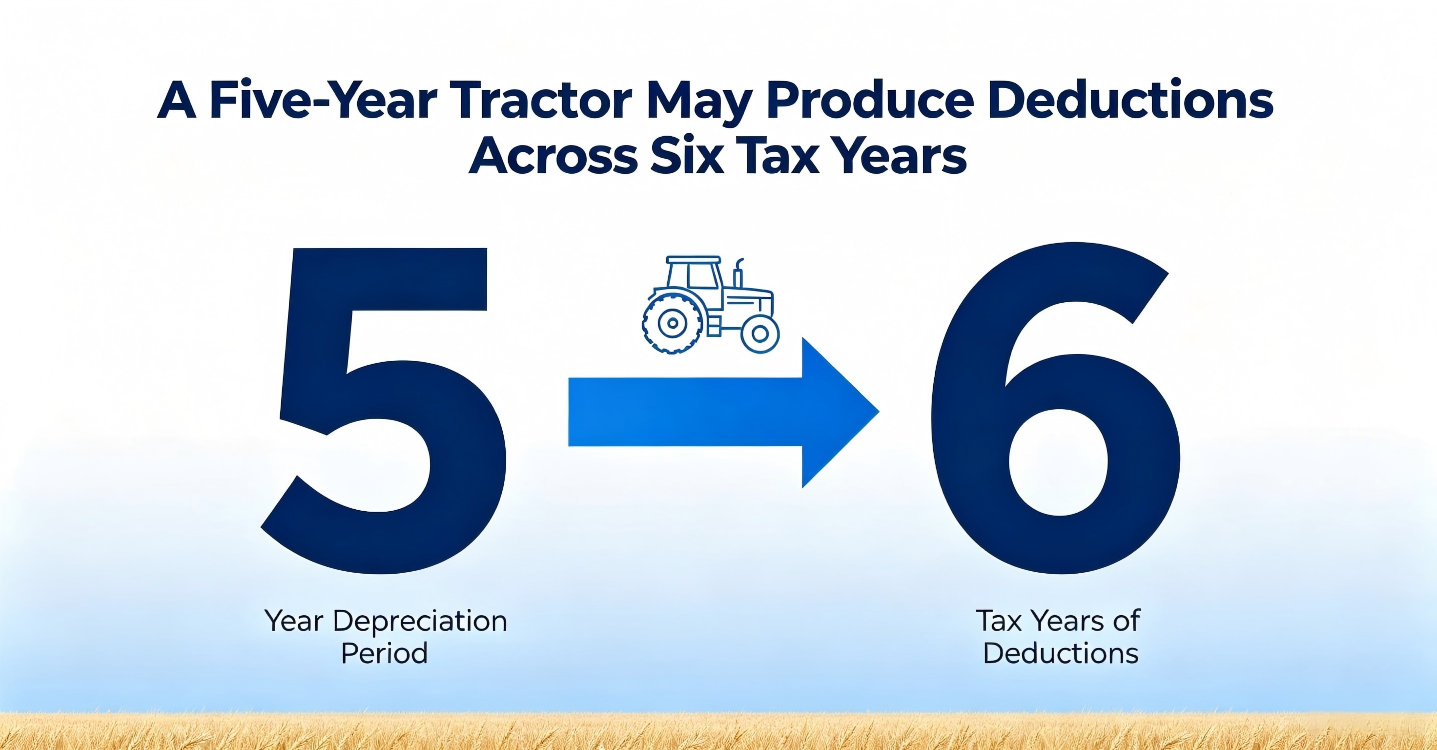
“Five-year property” does not necessarily mean the tax deductions appear in only five tax returns. The recovery period does not necessarily mean that the entire deduction appears on exactly five tax returns. The applicable depreciation convention determines how deductions are allocated between the first and final tax years.
For example, assume a farm purchases and places a new tractor in service during the year, uses it 100% for the business, and does not use an immediate-expensing election. The farm may claim a partial deduction in Year 1, larger deductions during the middle recovery years, and a final partial deduction in Year 6.
This timing rule is one reason farmers should not divide the purchase price by five and assume that amount will be deducted every year. The annual result depends on the selected depreciation method and convention.
A tractor generally becomes depreciable when it is ready and available for use in the farming business. Ordering a tractor, making a deposit, or taking delivery does not always establish the same date.
For instance, a tractor delivered in December may not be placed in service until it has been prepared, fitted with the required implements, and is ready for actual farm work. Conversely, a tractor purchased early in the year may qualify for depreciation even if it is only used seasonally, provided it was ready and available for business use.
Keep clear records of:
Purchase agreement and invoice
Delivery date
Date the tractor was first ready for farm use
Financing documents
Trade-in information
Installation or implement costs that may affect basis
Meter readings, work logs, and business-use records
Repair and maintenance invoices
Good records make it easier to calculate the deduction, support the farm’s tax position, and determine gain or loss if the tractor is sold later.
The starting value for depreciation is generally the tractor’s cost basis. This may include the purchase price and certain costs necessary to acquire and prepare the equipment for use. Freight, delivery, setup, and qualifying accessories may need to be considered when establishing the correct basis.
A trade-in can also affect the transaction. If an older tractor is traded toward a replacement, the tax consequences may be more complex than simply subtracting the trade-in allowance from the price of the new machine. Financing does not prevent depreciation, but loan principal and interest are treated differently: the equipment cost is depreciated, while qualifying interest may be handled separately as a business expense.
The tax basis can also be reduced by immediate expensing or accelerated depreciation claimed in the first year. That reduced basis is then used to calculate the remaining annual depreciation.
Only the portion of tractor use connected to the farming business is generally eligible for business depreciation. A machine used entirely for commercial farming is easier to document than one that also performs personal landscaping, hobby-farm work, or non-business property maintenance.
If a tractor is used 80% for eligible farm operations and 20% for personal work, the farm may generally depreciate only the 80% business portion. The same percentage may matter when determining related operating costs, repairs, insurance, and fuel deductions.
Mixed use is not inherently a problem, but it requires consistent records. A simple work log that identifies the date, task, field or property, hours used, and business purpose can be valuable. If business use falls substantially after accelerated deductions have been claimed, additional tax consequences may arise.
In some circumstances, a farm may elect to deduct a substantial portion—or potentially all—of the cost of qualifying equipment in the year it is placed in service instead of depreciating it gradually. Immediate-expensing provisions and bonus depreciation rules can make this possible, subject to eligibility requirements, annual limits, taxable-income considerations, and current law.
This can be attractive when the farm has strong taxable income and wants to reduce the current-year tax burden. However, a larger deduction today means less depreciation remains for future years. The best choice depends on the farm’s cash flow, expected profitability, equipment-purchase plan, ownership structure, and longer-term tax strategy.
A good decision is not automatically “take the fastest deduction.” Some operations benefit from preserving deductions for later years, especially when current income is low or future income is expected to rise.
The standard five- or seven-year treatment is not the only possibility. In certain situations, a longer alternative depreciation system may be required or elected. For farm machinery, the alternative system commonly uses a ten-year recovery period and straight-line depreciation.
Situations that may require closer review include:
Property used predominantly outside the United States
Certain farm-business elections
Tax-exempt use or tax-exempt financing
Imported-property rules in particular circumstances
An election to use a different depreciation method
Business structures or transactions with specialized tax treatment
Because these rules can materially change the annual deduction, it is wise to identify the required system before filing rather than correcting the treatment later.
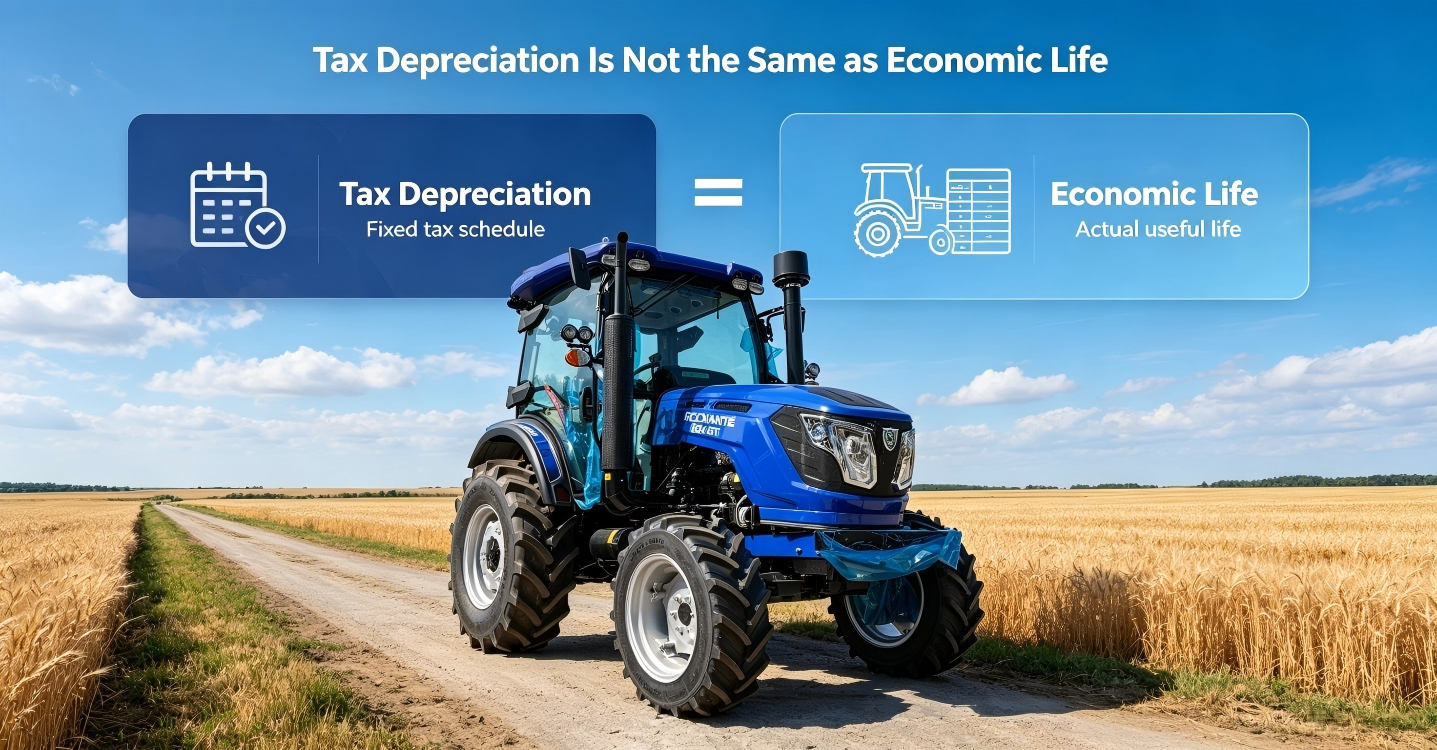
A five-year tax recovery period does not mean a tractor should be replaced after five years. Many equipment owners evaluate a tractor over a much longer operating horizon based on engine hours, maintenance practices, workload, operator habits, local climate, and access to parts and service.
A practical ownership review should consider:
Factor | Why it matters |
Annual operating hours | Higher use can increase wear and affect replacement planning |
Load and implement demands | Heavy tillage, loader work, and hauling may place more stress on the machine |
Maintenance discipline | Timely fluid changes, filters, inspections, and repairs support longer service life |
Parts and technical support | Readily available support reduces downtime and protects long-term value |
Resale value | A tractor may still have significant market value after it is fully depreciated |
Technology needs | Precision systems, comfort features, emissions requirements, and implement compatibility may influence upgrade timing |
For this reason, the tax schedule should inform financial planning but should not replace equipment-management decisions. A tractor can be fully depreciated for tax purposes and still be one of the farm’s most valuable and reliable assets.
The right tractor is not simply the lowest-cost machine or the model with the highest horsepower. It should match the jobs that generate the most value on the farm: tillage, planting, mowing, spraying, loader work, transport, orchard tasks, or livestock operations.
When comparing options, assess horsepower, traction, hydraulic capacity, PTO requirements, hitch category, operator environment, ground clearance, fuel efficiency, and compatibility with existing implements. Buying too small can create downtime and overload the machine. Buying too large can raise acquisition, fuel, and maintenance costs without improving output.
A well-matched tractor also supports more predictable operating costs over its working life. Explore Agrotianda’s farm tractor range to compare equipment configurations designed for different farm sizes and working conditions.
Selling, trading, or disposing of a tractor can create a gain or loss. The result is generally based on the difference between the amount received and the tractor’s adjusted tax basis after depreciation. If the tractor has been heavily depreciated, a sale price that seems modest may still create taxable gain or depreciation recapture.
This is why equipment records should be retained throughout ownership and beyond the sale. Keep the original cost, additions to basis, annual depreciation claimed, date placed in service, and disposal documents together. These details help the farm calculate the correct result and avoid treating the sale as an ordinary equipment transaction with no tax impact.
For most U.S. farm businesses, depreciate a new farm tractor over five years and a used farm tractor over seven years. The actual deduction pattern may extend into a sixth or eighth tax year because of the applicable convention, and special elections may allow faster deductions or require a different schedule.
Before making a final tax decision, verify whether the tractor is new or used, establish the date it was placed in service, calculate the eligible business-use percentage, and consider whether immediate expensing or an alternative method fits the farm’s overall plan. For help selecting a tractor that suits your operation and long-term workload, contact Agrotianda.
A new farm tractor is generally depreciated over five years for U.S. tax purposes. A used farm tractor is generally depreciated over seven years. The correct classification depends on the machine’s condition and tax status when it is first placed in service by the farm.
Only qualifying business use may be eligible for depreciation. A tractor used solely for personal, recreational, or hobby purposes is generally not depreciable as farm-business equipment. Mixed-use tractors require a reasonable allocation based on documented business use.
Possibly. Some equipment may qualify for immediate expensing or accelerated depreciation, subject to current rules, limits, and eligibility conditions. A tax professional can help determine whether taking the largest first-year deduction is the best choice for your farm.
Depreciation generally starts when the tractor is placed in service—meaning it is ready and available for use in the farm business—not simply when it is ordered, financed, or delivered.
Routine maintenance and ordinary repairs are commonly treated differently from capital improvements. A major improvement that adds value, extends useful life, or adapts the tractor to a new use may need to be capitalized, while routine service may be currently deductible. Keep invoices and discuss unusual work with your tax adviser.
Yes. A tractor can be fully depreciated for tax purposes while continuing to deliver useful work and resale value. Tax depreciation and economic value follow different timelines.
Select a machine that matches your workload, implements, terrain, and required power rather than choosing solely by purchase price. Durable construction, compatible attachments, timely maintenance, and dependable parts support all help protect long-term value.


