

Views: 0 Author: Site Editor Publish Time: 2026-05-12 Origin: Site
Rice is a principal staple crop that is cultivated to a significant extent around the world including in the Southeast Asian, Middle Eastern, African, and South American regions. More than one-third of the grain-growing area throughout Southeast Asia is used to produce rice crops, while large-scale developments of the rice industries are underway in both Africa and South America. Farmers from major rice producing areas outside of the United States continue to use multi-purpose dryland Tractors fitted with specially selected sizes of tires for rice farming. Since the modifications being made to general purpose tractors allow the addition of the special paddy field tires, farmers do not have to invest in dedicated paddy field-type Tractor units. Not only is this method of cultivation able to satisfy all local rice farming requirements while expanding the range of application for tractors, it creates an opportunity for agricultural equipment exporters to better match the requirements of international markets and will allow them to adjust to variations in agricultural processes among regions, and helps agricultural machinery exporters to grow their overseas businesses over time.
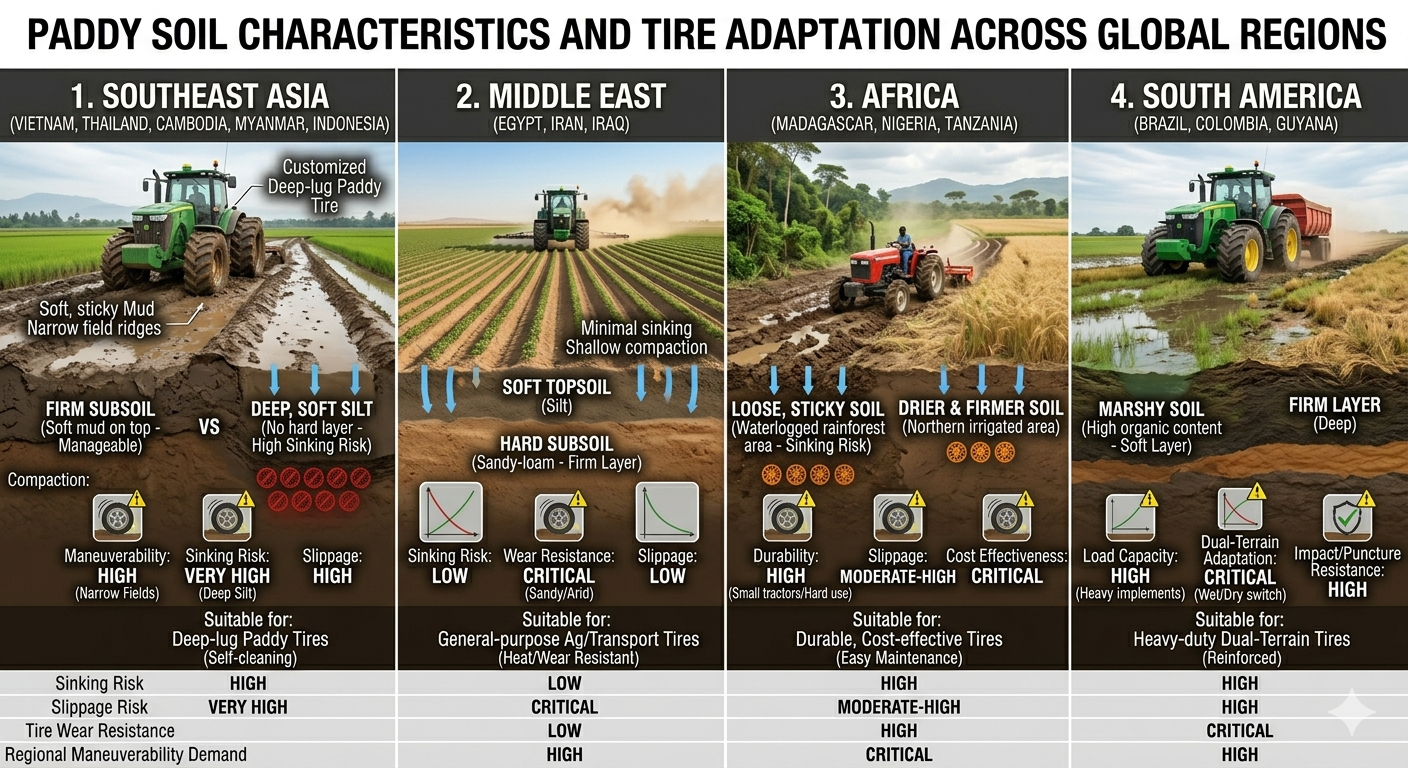
Paddy soil is usually soft, loose, and sticky. These properties make machinery prone to sinking, wheel slippage, and high rolling resistance. Choosing the wrong tire can seriously affect tractor performance. Soil characteristics differ by region:
Fields in Vietnam, Thailand, Cambodia, Myanmar, and Indonesia often experience heavy rain and long waterlogged periods. Some fields have a firm subsoil with soft mud on top, which is manageable for tractors. Others are deep, soft silt with no hard layer underneath—tractors can get stuck easily. Small fields with narrow ridges also require highly maneuverable machinery.
In countries like Egypt, Iran, and Iraq, paddy fields are mainly irrigated manually. Soil is sandy-loam with soft topsoil and hard subsoil. Muddy areas are rare. Dry conditions and occasional sandstorms mean tires need to resist wear and corrosion. Fields are typically large and uniform, which allows continuous tractor operation.
Rice-growing areas in Madagascar, Nigeria, and Tanzania show mixed conditions. Fields near rainforests are waterlogged with loose, sticky soil, causing slippage. Northern irrigated fields are drier and firmer. Farmers tend to use smaller tractors, so they value tires that are durable, easy to maintain, and cost-effective.
Brazil, Colombia, and Guyana have marshy fields with high organic content and very soft soil, so machinery can sink. Fields often switch between wet and dry areas, requiring tires that work well in both conditions. Large farms mean tractors carry heavy loads, so tires must resist impact and punctures.
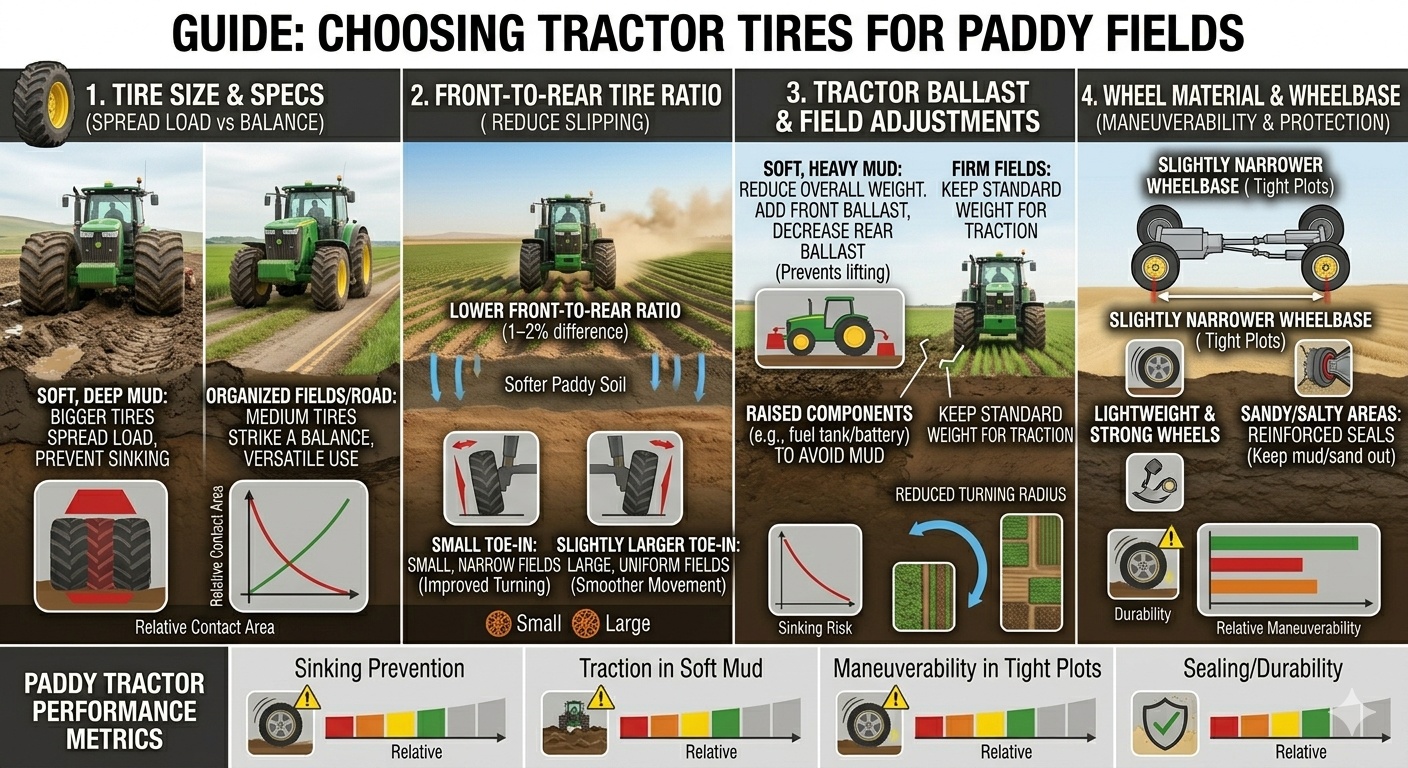
Tires determine how well a tractor moves and performs in the field. Picking the right tires for the conditions is crucial.
Start with the tractor’s factory specs. A tractor can often use different tire sizes depending on field conditions:
Soft, deep mud: Bigger tires spread the load and prevent sinking.
Organized fields with transport needs: Medium tires strike a balance between field traction and road use.
Paddy fields are softer than dryland fields, so tractors need a slightly lower front-to-rear tire ratio (about 1–2%) to reduce slipping. Adjust front wheel alignment:
Smaller toe-in for small, narrow fields to improve turning.
Slightly larger toe-in for large, uniform fields for smoother movement.
Soft, heavy mud: Reduce overall weight, add front ballast, and decrease rear ballast to prevent the front from lifting.
Firm fields: Keep standard weight for traction.
Also, raise sensitive components like the fuel tank and battery to avoid mud damage, and reduce turning radius to navigate narrow fields more easily.
Slightly narrower wheelbase improves maneuverability in tight plots.
Wheels should be lightweight but strong.
In sandy or salty areas, reinforce seals to keep mud and sand out.
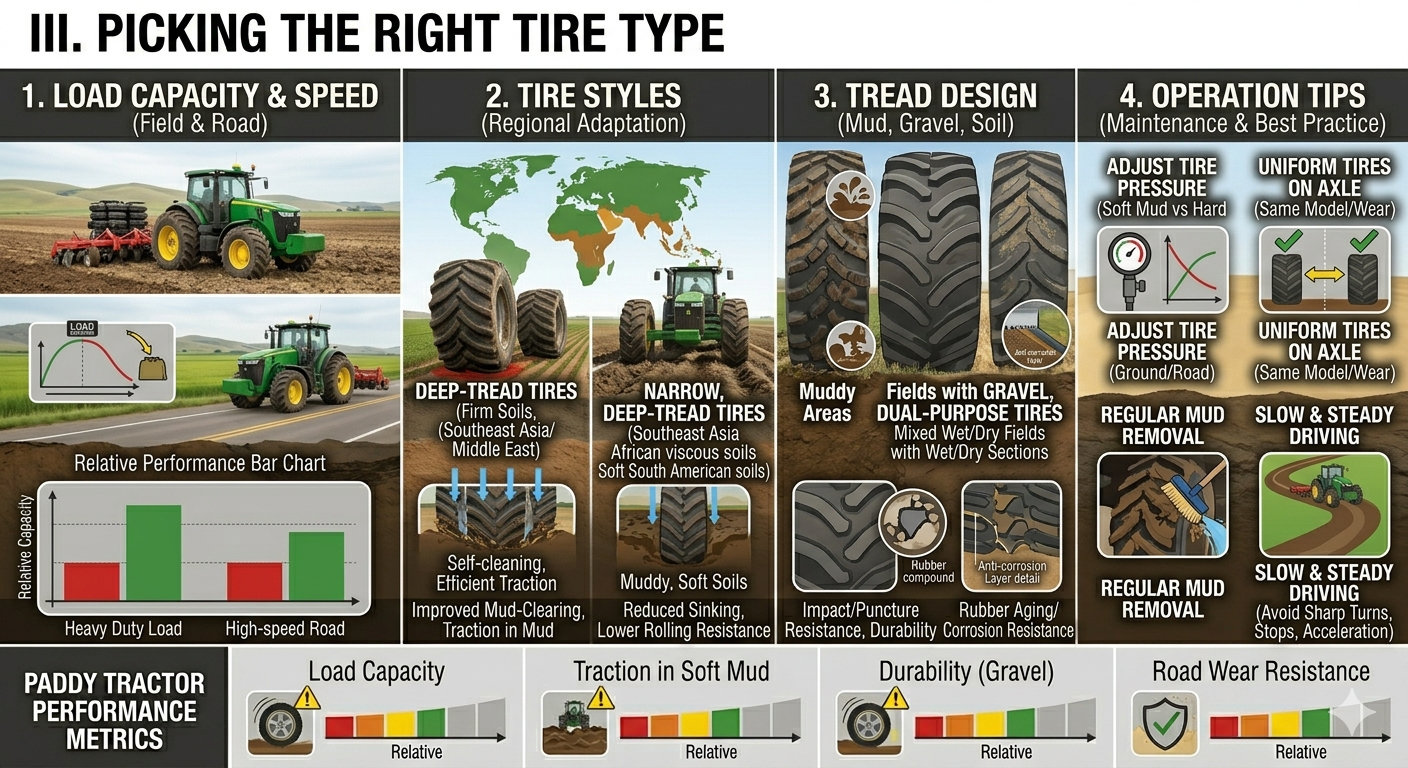
Make sure the tire can handle the tractor’s weight and speed—both for fieldwork and short road travel.
Deep-tread tires: Good for firm soils in Southeast Asia and irrigated Middle Eastern fields; provide traction and clean mud efficiently.
Narrow, deep-tread tires: Best for muddy Southeast Asian fields, viscous African soils, and soft South American soils; reduce sinking and rolling resistance.
Medium-tread, dual-purpose tires: Ideal for South American areas with mixed wet and dry fields; balance field traction and road wear.
Muddy areas: More tread blocks and proper angles improve stability.
Fields with gravel or weeds: Wide, thick treads increase durability.
Sandy or salty soils: Use rubber that resists aging and corrosion.
Adjust tire pressure: lower for soft mud, higher for hard ground or road use.
Keep tires on the same axle uniform; don’t mix models or wear levels.
Remove mud from treads regularly.
Drive slowly and steadily; avoid sharp turns, sudden stops, or acceleration to protect tires.
Understanding soil and field conditions is key to selecting the right tractor tires. The right tires improve efficiency, reduce breakdowns, and make tractors more adaptable to different regions. Fitting standard tractors with specialized paddy tires is a flexible, cost-effective solution that meets the needs of farmers and machinery dealers worldwide, helping exported machinery perform reliably in any paddy field.


